
We recently started a new series for 2025 about prophets in the Old Testament. We are doing this for several reasons, but the primary reasons are these:
God, who at various times and in various ways spoke in time past to the fathers by the prophets. Hebrews 1:1
Surely the Lord God does nothing, Unless He reveals His secret to His servants the prophets. Amos 3:7
Do not think that I came to destroy the Law or the Prophets. I did not come to destroy but to fulfill. Matthew 5:17
Then He said to them, ‘These are the words which I spoke to you while I was still with you, that all things must be fulfilled which were written in the Law of Moses and the Prophets and the Psalms concerning Me.’ And He opened their understanding, that they might comprehend the Scriptures. Luke 24:43-45
The Lord your God will raise up for you a Prophet like me from your midst, from your brethren. Him you shall hear. Deuteronomy 18:15
Moses spoke and wrote those words in Deuteronomy. He identified himself as a prophet and told the people of Israel that God would raise up for them “a Prophet” like him from their “brethren.” The Prophet Moses spoke about is Jesus Christ. As Jesus pointed out to His disciples prior to ascending back to Heaven following His death and resurrection, “the Law of Moses and the Prophets and the Psalms” were about Him – Jesus Christ, the eternal Son of God (Luke 24:44).
A Family of Prophets
Moses was a somewhat reluctant prophet. God called Moses to free His people from slavery in Egypt.
Now therefore, behold, the cry of the children of Israel has come to Me, and I have also seen the oppression with which the Egyptians oppress them. Come now, therefore, and I will send you to Pharaoh that you may bring My people, the children of Israel, out of Egypt. Exodus 3:9-10
Moses had personal doubts about his ability to do what God was calling him to do. Moses doubted his ability to speak to Pharaoh, so God chose Moses’ older brother to speak to the ruler what God revealed to Moses.
So the Lord said to Moses: ‘See, I have made you as God to Pharaoh, and Aaron your brother shall be your prophet. ‘You shall speak all that I command you. And Aaron your brother shall tell Pharaoh to send the children of Israel out of his land. And I will harden Pharaoh’s heart, and multiply My signs and My wonders in the land of Egypt. But Pharaoh will not heed you, so that I may lay My hand on Egypt and bring My armies and My people, the children of Israel, out of the land of Egypt by great judgments. And the Egyptians shall know that I am the Lord, when I stretch out My hand on Egypt and bring out the children of Israel from among them. Then Moses and Aaron did so; just as the Lord commanded them, so they did. And Moses was eighty years old and Aaron eighty-three years old when they spoke to Pharaoh. Exodus 7:1-7
Moses also had an older sister. She, too, was a prophet (prophetess).
Then Miriam the prophetess, the sister of Aaron, took the timbrel in her hand; and all the women went out after her with timbrels and with dances. Exodus 15:20
We’ll learn more about each of these prophets, but I first want to point to God’s call to this family. It’s a story worth remembering, not because it glorifies a particular family but because it glorifies God.
Moses, Aaron, and Miriam were born into a Hebrew Levite home. Their father, Amram, was a Levite who married Jochebed, also born into a Levite home. Amram lived to the age of 137 (Exodus 6:20). Aaron was three years older than Moses (Exodus 7:7). Miriam was the oldest of the three children, as we will see in a few minutes.
The pharaoh (king) of Egypt at the time of Moses’ birth was not familiar with how the Hebrew people had helped his country in the past (through Joseph), and was afraid of the growing Hebrew population. Pharaoh tried to get the Hebrew midwives to kill Jewish male newborns, but they wouldn’t do it. So, Pharaoh made a decree.
So Pharaoh commanded all his people, saying, ‘Every son who is born you shall cast into the river, and every daughter you shall save alive. Exodus 1:22
Moses’ mother hid him after his birth for about three months, then placed him in an ark of bulrushes, daubed it with asphalt and pitch, and placed baby Moses in the ark in the reeds by the river’s bank. Miriam, who was probably an adolescent or young teenager at the time, “stood afar off, to know what would be done to him” (Exodus 2:1-4).
The daughter of Pharaoh came down to the river to bathe, found the ark with Moses in it, and had compassion on him. Miriam spoke up and asked Pharaoh’s daughter if she would like for a Hebrew woman to nurse the child. Pharaoh’s daughter agreed, so Miriam got Moses’ mother to be his nursemaid. After a time, Moses was given to Pharaoh’s daughter to raise as her own son. She named him Moses, saying, “Because I drew him out of the water” (Exodus 2:10).
Moses grew up as a prince of Egypt, but fell out of favor with the pharaoh after killing an Egyptian who had beaten a Hebrew. In fear of being arrested, Moses ran for his life to the land of Midian. He was 40 years old at the time (Acts 7:23). Moses married the daughter of the priest of Midian, and fathered two sons (Acts 7:29; Exodus 2:16-22). Moses was content to tend sheep for his father-in-law and raise his family (Exodus 3:1).
After 40 years of living in Midian, God appeared to Moses “in the flame of fire in a bush, in the wilderness of Mount Sinai” (Acts 730; Exodus 3:2). That’s when God spoke to Moses and commanded him to return to Egypt and lead the Hebrews out of slavery (Acts 7:30-34; Exodus 3:2-22). Moses gave God several excuses about not doing what God commanded him to do. God’s response was to bring Aaron to Moses to become his spokesperson (prophet) to pharaoh (Exodus 4:1-17).
Moses asked permission from his father-in-law to return to Egypt. Moses took his wife and sons and returned to Egypt. Moses also took the “rod of God in his hand” (Exodus 4:20). God told Aaron to go into the wilderness to meet Moses. They met on the “mountain of God” and Moses told Aaron what God had told him. Moses and Aaron gathered all the elders of Israel together and Aaron “spoke all the words which the Lord had spoken to Moses.” They did signs in the sight of the people, so the people believed and worshiped God (Exodus 4:27-31).
Exodus chapters 5 – 14 include the amazing details of how God freed the children of Israel (Jacob) from Egyptian slavery. God showed His supreme power over all the gods of Egypt, and also introduced to Israel how people would be saved by blood and faith (the Passover – Exodus 12).
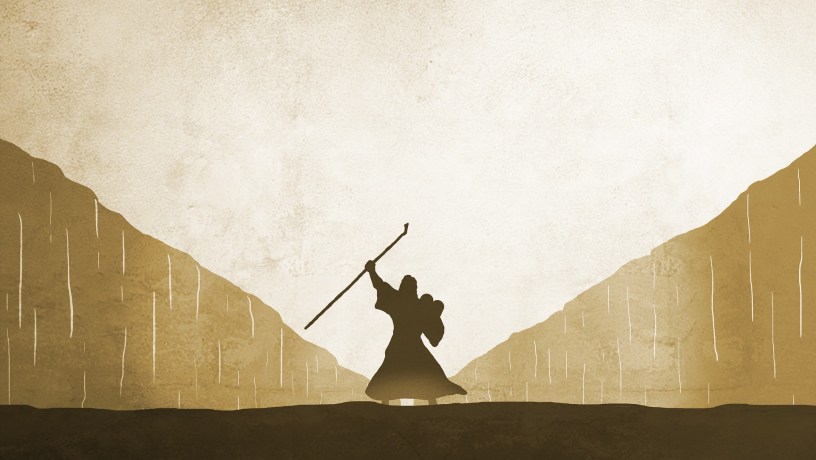
Moses and Aaron led the children of Israel out of Egypt, through the parting of the Red Sea, and into the safety of the wilderness (Exodus 14). As you might imagine, the Israelites were overjoyed at becoming free people and seeing the power of God displayed on their behalf. That led Moses, Aaron, and Miriam to lead the children of Israel in songs of praise to God (Exodus 15).
Moses and Aaron Challenged
It didn’t take long before the children of Israel began a series of challenges against Moses and Aaron’s leadership. Here’s what happened about six weeks after being freed from slavery:
And they journeyed from Elim, and all the congregation of the children of Israel came to the Wilderness of Sin, which is between Elim and Sinai, on the fifteenth day of the second month after they departed from the land of Egypt. Then the whole congregation of the children of Israel complained against Moses and Aaron in the wilderness. And the children of Israel said to them, ‘Oh, that we had died by the hand of the Lord in the land of Egypt, when we sat by the pots of meat and when we ate bread to the full! For you have brought us out into this wilderness to kill this whole assembly with hunger. Exodus 16:1-3
God responded to the people’s complaints by providing them with “bread from heaven.” The children of Israel ate the bread (called Manna) for 40 years in the wilderness (Exodus 16:4-36).
The people “contended” with Moses and Aaron again and demanded water (Exodus 17:1-3). The situation became so bad that the people said, “Is the Lord among us or not?,” and Moses was concerned the people were going to stone him to death (Exodus 17:4-7). God provided water for the people from “the rock in Horeb.”
The children of Israel had a lot of complaints against each other and came before Moses all day, every day, to present their complaints to him. Jethro, Moses’ father-in-law, saw the toll it was taking on Moses and recommended that Moses select “able men, such as fear God, men of truth, hating covetousness” to help him judge the people (Exodus 18). Moses took Jethro’s advice.
So Moses heeded the voice of his father-in-law and did all that he had said. And Moses chose able men out of all Israel, and made them heads over the people: rulers of thousands, rulers of hundreds, rulers of fifties, and rulers of tens. So they judged the people at all times; the hard cases they brought to Moses, but they judged every small case themselves. Exodus 18:24-25
Moses and his family would face many more challenges during 40 years in the wilderness with the children of Israel. We’ll look at more of those as our series continues.
Next Time
We’ll look at how God gave His Law to the prophet Moses in the next part of our special series and its impact on his family and the children of Israel.
Scripture taken from the New King James Version®. Copyright © 1982 by Thomas Nelson. Used by permission. All rights reserved.
GraceLife © 1990-2025

 GraceLife Blog