
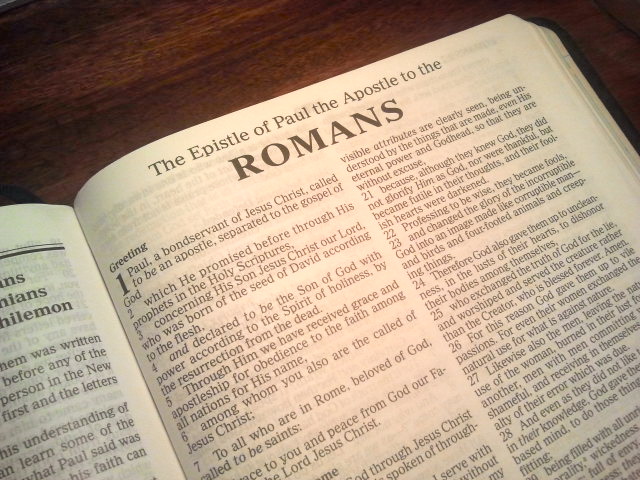
For sin, taking occasion by the commandment, deceived me, and by it killed me. Therefore the law is holy, and the commandment holy and just and good. Romans 7:11-12
We hope you are enjoying your study of Paul’s Epistle to the Romans. You can read the last part of our study here. We will link you to free eBooks from previous studies at the end of this article. Those eBooks cover Chapters 1-6 of Paul’s letter to the Romans.
We continue our study of Romans 7 beginning in verse 11.
Verses 11-12
For sin, taking occasion by the commandment, deceived me, and by it killed me. Therefore the law is holy, and the commandment holy and just and good.
η γαρ αμαρτια αφορμην λαβουσα δια της εντολης εξηπατησεν με και δι αυτης απεκτεινεν ωστε ο μεν νομος αγιος και η εντολη αγια και δικαια και αγαθη
The Apostle Paul was a great teacher and debater. He used a variety of ways of connecting with his audience for the purpose of guiding them toward the Gospel of Christ. Truth was always Paul’s objective. One of the ways Paul communicated personally and in his letters was through asking questions — then answering them.
Paul was trained in Greek, Roman, and Hebrew methods of communication and debate. We see his skills on full display in the Book of Acts and in his letters to churches and individuals. Paul’s interest was in persuading people and for good reason. As he wrote in 2 Corinthians, “Knowing, therefore, the terror of the Lord, we persuade men” (2 Corinthians 5:11).
Paul used the process of reasoning with people that included explanations and demonstrations concerning what was true.
Then Paul, as his custom was, went in to them, and for three Sabbaths reasoned with them from the Scriptures, explaining and demonstrating that the Christ had to suffer and rise again from the dead, and saying,“This Jesus whom I preach to you is the Christ.’ And some of them were persuaded; and a great multitude of the devout Greeks, and not a few of the leading women, joined Paul and Silas. Acts 17:3-4
Paul was able to talk with people of many backgrounds. One example is when he ministered in Athens, Greece.
Now while Paul waited for them at Athens, his spirit was provoked within him when he saw that the city was given over to idols. Therefore he reasoned in the synagogue with the Jews and with the Gentile worshipers, and in the marketplace daily with those who happened to be there. Then certain Epicurean and Stoic philosophers encountered him. And some said, ‘What does this babbler want to say?’ Acts 17:16-18
Paul reasoned with Jews and Gentile worshipers in the synagogue, in the marketplace with anyone who happened to be there, and with Epicurean and Stoic philosophers who encountered him. One of Paul’s most powerful demonstrations of reasoning with philosophers is found in Acts 17:2-31.
We see Paul using his reasoning skills effectively with both Jews and Gentiles in his letter to the Romans. He used the process of questions and answers in Chapter Two —
And do you think this, O man, you who judge those practicing such things, and doing the same, that you will escape the judgment of God? Or do you despise the riches of His goodness, forbearance, and longsuffering, not knowing that the goodness of God leads you to repentance? Romans 2:3-4
Paul asked and answered almost 80 questions in his letter to the Romans and we find five of them in Chapter 7 —
- Or do you not know, brethren (for I speak to those who know the law), that the law has dominion over a man as long as he lives?
- What shall we say then?
- Is the law sin?
- Has then what is good become death to me?
- Who will deliver me from this body of death?
Our current verse (11) is part of Paul’s answer to the questions – “What shall we say then? Is the law sin?” His answer included several important points —
- Certainly not! On the contrary, I would not have known sin except through the law.
- For I would not have known covetousness unless the law had said, ‘You shall not covet.’
- But sin, taking opportunity by the commandment, produced in me all manner of evil desire.
- For apart from the law sin was dead.
- I was alive once without the law, but when the commandment came, sin revived and I died.
- And the commandment, which was to bring life, I found to bring death.
- For sin, taking occasion by the commandment, deceived me, and by it killed me.
- Therefore the law is holy, and the commandment holy and just and good.
Verses 11 and 12 are at the end of Paul’s answer to these questions.
η γαρ αμαρτια (hē gar hamartia) “the for sin” .. the word sin means “missing the mark” .. it was the idea of failure or loss
αφορμην λαβουσα δια της εντολης (aphormēn labousa dia tēs entolēs) “an occasion having taken by the commandment” .. the word aphormēn means “starting point, launching point, opportunity) .. the starting point for “sin” was “taken by the commandment” .. the word translated “commandment” is entolēs and means “an ordinance, commandment, law, injunction, precepts” .. the word is used through the New Testament in the context of religious and moral precepts .. the word comes from a combination of the words en (in) and télos (consummation, principal end, end goal, purpose) ..
This is similar to what Paul wrote a few sentences earlier — “But sin, taking opportunity by the commandment” (verse 8). Paul mentioned it again in the next verse — “I was alive once without the law, but when the commandment came, sin revived and I died” (verse 9). The next sentence is — “And the commandment, which was to bring life, I found to bring death” (verse 10).
It’s important to observe verses in their context before rushing to interpretation. It’s also important to notice when a particular word or phrase is repeated in the same context. Paul asked a question in verse 7, then used these words repeatedly in his answer —
- law (five times)
- sin (five times)
- commandment (five times)
It would appear from reading Romans 7:7-12 that those three words were important to understand. A good process for Bible study is to —
- Observe everything
- Ask questions for interpretation about everything observed
- Make an interpretation based on careful observation and answers to questions
- Move to application in both doctrine and practice after making a proper interpretation
εξηπατησεν με (exēpatēsen me) “deceived me” .. the word exēpatēsen means “seduce wholly, deceive thoroughly) .. this is the end product of deception ..
και δι αυτης απεκτεινεν (kai di autēs apekteinen) “and by it put me to death” .. the word apekteinen means “to kill, put to death, abolish” .. the word is used both literally and figuratively .. Paul used the word figuratively in this context ..
ωστε ο μεν νομος αγιος και η εντολη αγια και δικαια και αγαθη (hōste ho men nomos hagios kai hē entolē hagia kai dikaia kai agathē) “so indeed the law is holy and the commandment is holy and righteous and good” .. the word for law (nomos) means “that which is assigned, law” .. usually used in reference to the Mosaic Law (Scripture) .. the word for commandment (entolē) means “an injunction, order, command) .. the word intensifies the word telos (an end, consummation) and looks at the end result of a command .. the law of God is “holy,” as is the result of the commandments contained in the law .. the commandments are holy, righteous, and good .. holy means “set apart by (or for) God, holy, sacred” .. righteous means “correct, just, innocent” .. good means “intrinsically good, inherently good, good in nature” ..
God gave His Law, with specific commandments, to His people. That law is holy because the great God who gave it is Holy. The commandments are holy and righteous and good. God’s Law is perfect and shines a holy light on our sinful nature. It guides us to Jesus Christ as the only God/Man who is holy, righteous, and good. It is only through the holiness of Christ that we can be saved and live in ways that please God.
Other Commentary
Notice yet again how Paul blames sin and clears the law of any accusation .. Some people say that here Paul is not talking about the law of Moses but rather about the law of nature or of the commandment given in paradise. But surely Paul’s aim is to reach beyond the authority of the law of Moses; he has no quarrel because the Jews feared the abolition of their law that they so obstinately opposed the working of grace, Moreover, it does not appear that Paul ever called the commandment given in paradise a law, nor has any other writer. Following Paul;’s logic, let us pursue the argument a little further. Having spoken to the Romans about proper standards of behavior, Paul goes on to say: “Do you not know, brethren–for I am speaking to those who know the law–that the law is binding on a person only during his life? But you are discharged from the law.” Now if these things had been said about the natural law, we would now be without it. And if that were true, we would be more senseless than the irrational creatures are. But surely this is not so. Chrysostom, Homilies on Romans (4th century AD)
Sin played the tempter, and then made use of the Commandment to condemn and destroy its victims. Ellicott’s Commentary for English Readers
Yet this result is not due to the commandment in itself. It is indwelling sin, inherited from Adam, which, when it has found a base of operations, employs the commandment to deceive (cf. Genesis 3:13) and to kill. “Sin here takes the place of the Tempter” in Genesis (S. and H.). Expositor’s Greek Testament
When the commandment came to his conscience by the convictions of the Holy Spirit, and he saw what it demanded, he found his sinful mind rise against it. He felt at the same time the evil of sin, his own sinful state, that he was unable to fulfil the law, and was like a criminal when condemned. But though the evil principle in the human heart produces sinful motions, and the more by taking occasion of the commandment; yet the law is holy, and the commandment holy, just, and good. Matthew Henry’s Concise Commentary
The meaning here seems to be, that his corrupt and rebellious propensities, excited by the Law, led him astray; caused him more and more to sin; practiced a species of deception on him by urging him on headlong, and without deliberation, into aggravated transgression. In this sense, all sinners are deceived. Their passions urge them on, deluding them, and leading them further and further from happiness, and involving them, before they are aware, in crime and death. Barnes’ Notes on the Bible
Holy, and just, and good: the three epithets here given the law of God may be thus distinguished; it is holy in respect of the ceremonial part, it is just in respect of the judicial part, and good in respect of the moral part of it. Or else the law is holy, as it teacheth us our duty unto God; just, as it showeth us our duty to our neighbour; good, in regard of the effect and end, as it works goodness in the observer thereof, and is conducive to his temporal and eternal good. Matthew Poole’s Commentary
By “the law” is meant the whole body of the precepts of it in general; and by the commandment, either the same, or everyone of the commandments in particular, and especially that which is cited, “thou shall not covet”. Some have thought that the three properties of it design the threefold division of the law; and suppose that by that which is “holy” is meant the ceremonial law, which sanctified to the purifying of the flesh; by that which is “just”, the judicial law, which pointed out to the Jewish commonwealth what was right and wrong; and by that which is “good”, the moral law in all its precepts: but nothing is more certain, than that the moral law is only spoken of in this context, which may be said to be holy, because of its author, the holy God, from whom nothing can come but what is holy; and because of the matter of it, it is a transcript of the holy nature of God, a declaration of his holy will; it requires holiness both of heart and life; it forbids whatever is unholy, and commands nothing but what is holy; it teaches men to live holy, sober, righteous, and godly lives. It may be truly called just, or righteous, as it demands perfect obedience to all its precepts, or it will not admit of it as a righteousness; as it pronounces guilty, curses and condemns for every disobedience of it; as it deals impartially with persons the transgressors of it; and as it acquits believers upon the foot of the righteousness of Christ, the fulfilling end of it. It is rightly called good, from the author of it, God, from whom every good thing comes, and nothing else; from the matter of it, and from the use of it both to saints and sinners. Gill’s Exposition of the Entire Bible
Paul expected his Christian life under law to issue in the production of a testimony and experience that would be a living one, alive with the life of God, and this, accomplished through his attempt at law-obedience. But he found that mere effort at obeying an outside law resulted in defeat. The law, using the evil nature in him as a fulcrum, brought out sin all the more, and this condition he calls death. Wuest’s Word Studies in Romans
Sin is personified again here and is the tempter. Sin tempts every man outside the Garden of Eden relative to himself and God. In the Garden of Eden Satan made man believe that God could not be trusted and that man was able to become god, apart from God. Sin, like a Pied Piper, leads the children of men into believing that they can keep the Law and that God is not needed. This is the false trail that he has been talking about, which leads to death. It was ordained to life, Paul says, and he found it led him to death. Sin at last will kill, for the Law did bring the knowledge of sin, and man is without excuse. Again, the difficulty is not with the Law, but within man. J. Vernon McGee, Romans, Through the Bible
sin…deceived me. By leading him to expect life from his keeping of the law, when what he found was death (v. 10); and by convincing him that he is acceptable to God because of his own merit and good works. The fact that the law reveals, arouses, and condemns sin, bringing death to the sinner, does not mean that the law is evil (cr. 7). Rather the law is a perfect reflection of God’s holy character (cf. vv. 14, 16, 22; Ps. 19:7-11) and the standard for believers to please him. McArthur Study Bible, p 1554
Romans Resources
Commentary on Romans “The Gospel of God” Chapter 1 Verses 1-15
Commentary on Romans “The Gospel of God” Chapter 1 Verses 16-17
Commentary on Romans “The Gospel of God” Chapter 1:18 – 25
Commentary on Romans “The Gospel of God” Chapter 1:25-32
Commentary on Romans “The Gospel of God” Chapter 2:1-29
Commentary on Romans “The Gospel of God” Chapter 3
Commentary on Romans “The Gospel of God”Chapter 4
Commentary on Romans “The Gospel of God” Chapter 5
Commentary on Romans “The Gospel of God” Chapter 6
Next Time
We will look at Romans 7:13-14 in the next part of our study of the Gospel of God.
Scripture taken from the New King James Version®. Copyright © 1982 by Thomas Nelson. Used by permission. All rights reserved.
GraceLife © 1990-2025

 GraceLife Blog