
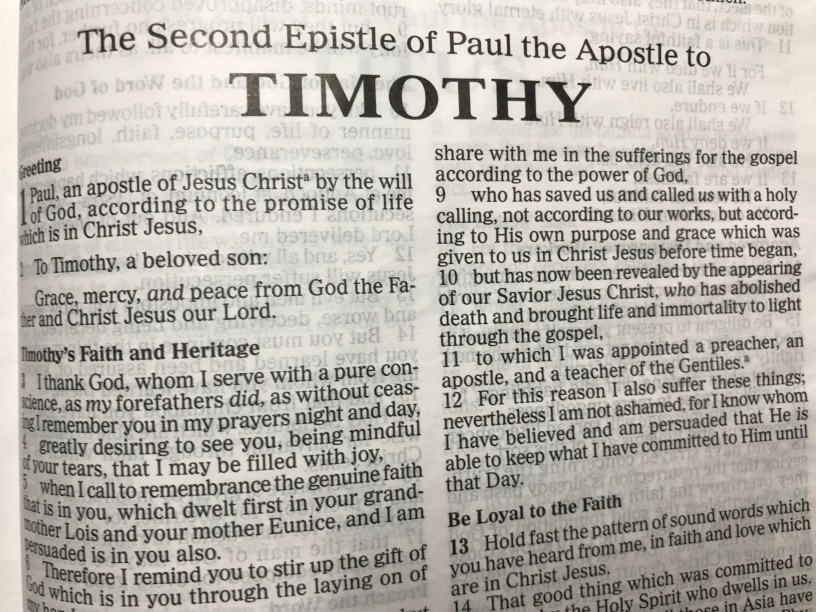
Paul’s final words to Timothy (and to us) include some honest and stark realities. I would expect that from an apostle of Christ, especially an apostle who was about to die for preaching the Gospel.
Being a Christian is not easy. Being a Christian leader is even harder. That was a message Paul wanted Timothy to hear from him again before he died. Paul and Timothy had spent years traveling and ministering together, so Timothy knew what Paul had endured as a preacher of the Gospel of Jesus Christ. However, Paul wanted to make sure Timothy understood that after his (Paul’s) martyrdom, things would become more challenging and difficult for the young preacher.
Paul’s first letter to Timothy had 1,591 words. Paul’s second letter to Timothy had 1,238 words .. about 353 fewer than the first letter. However, even though a bit shorter I think we’ll find 2 Timothy to contain deep truths for the Christian life and ministry that will resonate for all of our years on earth.
These are words we all need to hear and follow. If you haven’t read the first two parts of this series, please read them here and here.
Strength in God’s Grace
You therefore, my son, be strong in the grace that is in Christ Jesus. And the things that you have heard from me among many witnesses, commit these to faithful men who will be able to teach others also. You therefore must endure hardship as a good soldier of Jesus Christ. No one engaged in warfare entangles himself with the affairs of this life, that he may please him who enlisted him as a soldier. And also if anyone competes in athletics, he is not crowned unless he competes according to the rules. The hardworking farmer must be first to partake of the crops. Consider what I say, and may the Lord give you understanding in all things … Therefore I endure all things for the sake of the elect, that they also may obtain the salvation which is in Christ Jesus with eternal glory. 2 Timothy 2:1-7, 10
Paul addressed Timothy as his ‘son.’ Timothy was Paul’s ‘son’ in the Christian faith as well as the ministry (1 Corinthians 4:17; 1 Timothy 1:2, 18). The apostle had known Timothy from the time he was either a teenager or young man (Acts 16:1-5; 2 Timothy 1:5). Timothy had demonstrated his faithfulness to Jesus Christ, the Apostle Paul, and the ministry of the Gospel to the lost and to the saved. He had done this for many years, which is a true test of one’s faithfulness given the many difficulties the young man faced in serving with the Apostle Paul.
As Paul neared the end of his life on earth he wanted to remind Timothy to “be strong in the grace that is in Christ Jesus.” Paul’s life and message centered on the grace of Christ. Paul knew that it Christ’s grace that gave him the strength to carry on the Gospel ministry even in the face of great persecution and many dangers (2 Corinthians 11).
The Gospel Process
And the things that you have heard from me among many witnesses, commit these to faithful men who will be able to teach others also. 2 Timothy 2:2
This is one of my favorite Bible verses because it demonstrates the simple process of spreading the ‘good news’ (Gospel) of Jesus Christ. Paul told Timothy to take the things that he had heard the apostle say “among many witnesses” and ‘commit’ those same things to ‘faithful men’ who will be able to teach others. I’ve long referred to it as ‘The Timothy Principle.’
I remember teaching about this principle in the 1970s and explaining how sharing the Gospel with one person could easily lead to a world-wide revolution for the Gospel. It’s the spiritual and mathematical process of ‘multiplication.’ The Spirit of God calls and regenerates lost souls, but He also calls Christians to preach the Gospel. It is the same thing Jesus told His disciples –
Go therefore and make disciples of all the nations, baptizing them in the name of the Father and of the Son and of the Holy Spirit, teaching them to observe all things that I have commanded you… Matthew 28:19-20a
… you shall be witnesses to Me in Jerusalem, and in all Judea and Samaria, and to the end of the earth. Acts 1:8b
This is not complicated. Go – make disciples – baptize – teach. Where? Everywhere.
Paul called this ‘Gospel’ process the ‘ministry of reconciliation –
Now all things are of God, who has reconciled us to Himself through Jesus Christ, and has given us the ministry of reconciliation, that is, that God was in Christ reconciling the world to Himself, not imputing their trespasses to them, and has committed to us the word of reconciliation. Now then, we are ambassadors for Christ, as though God were pleading through us: we implore you on Christ’s behalf, be reconciled to God. 2 Corinthians 5:18-20
To ‘reconcile’ is the Greek word καταλλάσσω and means ‘change, exchange, transform.’ Sinners must be reconciled to their Creator. Since “all have sinned and fall short of the glory of God” (Romans 3:23), we must all be ‘reconciled’ to God. How?
Much more then, having now been justified by His blood, we shall be saved from wrath through Him. For if when we were enemies we were reconciled to God through the death of His Son, much more, having been reconciled, we shall be saved by His life. And not only that, but we also rejoice in God through our Lord Jesus Christ, through whom we have now received the reconciliation. Romans 5:9-11
Paul called on Timothy to be ‘strong in the grace that is in Christ Jesus’ and to ‘commit’ what he had heard Paul say to others who would do the same. The word ‘commit’ is the Greek verb παρατίθημι and means ‘to place beside, to set before, to set next to.’ It carries the idea of ‘entrusting’ someone with something important. Paul trusted Timothy. He called on Timothy to ‘commit’ Paul’s words to ‘trustworthy’ (faithful) men who would preach the pure Gospel and ‘commit’ the truth to other faithful, trustworthy men. That’s the Gospel process.
Not An Easy Task
I wrote earlier that the Gospel process is ‘not complicated.’ However, I did not mean that the process would be ‘easy.’ Just the opposite. Preaching and teaching the Gospel will be one of the most difficult things a Christian will ever do. That’s why Paul wrote these words next –
You therefore must endure hardship as a good soldier of Jesus Christ. No one engaged in warfare entangles himself with the affairs of this life, that he may please him who enlisted him as a soldier. And also if anyone competes in athletics, he is not crowned unless he competes according to the rules. The hardworking farmer must be first to partake of the crops. Consider what I say, and may the Lord give you understanding in all things.
Notice that Paul began by telling Timothy, “You therefore must endure hardship.” The Greek word translated ‘endure hardship’ is συγκακοπαθέω. It means ‘share in suffering, to bear evil treatment along with others.’ The idea is of ‘enduring hardship with someone as a co-sufferer.’ Christians are not in this alone. Yes, we have God in our corner and nothing can defeat us (Romans 8). However, Paul was telling Timothy that he would suffer for the Gospel – even as Paul had suffered greatly – but Timothy would not suffer alone. He would ‘bear evil treatment’ with other Christians who were committed to the preaching of the Gospel. We can ‘endure’ suffering and evil treatment because of our God and those with whom we ‘co-suffer.’
Paul then gave Timothy three examples of productive people who ‘endured hardship’ –
- soldier
- athlete
- farmer
Each of these individuals would be productive if they did certain things –
- soldier – “No one engaged in warfare entangles himself with the affairs of this life, that he may please him who enlisted him as a soldier.”
- athlete – “he is not crowned unless he competes according to the rules.”
- farmer – “must be first to partake of the crops.”
Paul wanted Timothy, and the men he would train to train others, to be productive. Paul wanted Timothy to remember how Paul had suffered for the Gospel and understand that all who serve Christ Jesus faithfully would suffer. That’s why it was important for Timothy to have those examples. That’s why it’s important for us to also have those examples and not forget what it means to be a faithful follower of Jesus Christ.
Consider What Paul Said
Paul then wrote – “Consider what I say, and may the Lord give you understanding in all things.” The Greek word for ‘consider’ is νοέω. It means ‘think, to perceive, understand, apprehend, consider.’ The idea is to apply mental effort that would lead to correct conclusions. Paul wanted Timothy to seriously think about what he had said. The apostle also added his prayerful hope that God would give Timothy “understanding in all things.”
It’s one thing to ‘hear’ what someone says. It’s another to ‘understand’ what they say. Paul wanted Timothy to succeed in his ministry, especially in light of the apostle’s impending martyrdom. Paul also wanted Timothy to understand what he was saying because Timothy would need to help others understand these truths for their ministry to others.
A friend of mine in martial arts likes to say, ‘perfect practice makes perfect.’ If we get Christian principles wrong and practice imperfectly, that’s how we’ll pass along those principles to others. However, if we get those principles correct, we’ll pass them along correctly. That’s the idea of “rightly dividing the word of truth” – handling God’s Word correctly.
We need a lot more of that in the Church today – handling God’s Word correctly!
Next Time
We’ll look at “rightly dividing the word of truth” and Paul’s strong words to Timothy about being an ‘approved’ worker for Christ in the next part of our new series, The Last Words of the Apostle Paul.
GraceLife © 1990-2025

 GraceLife Blog