
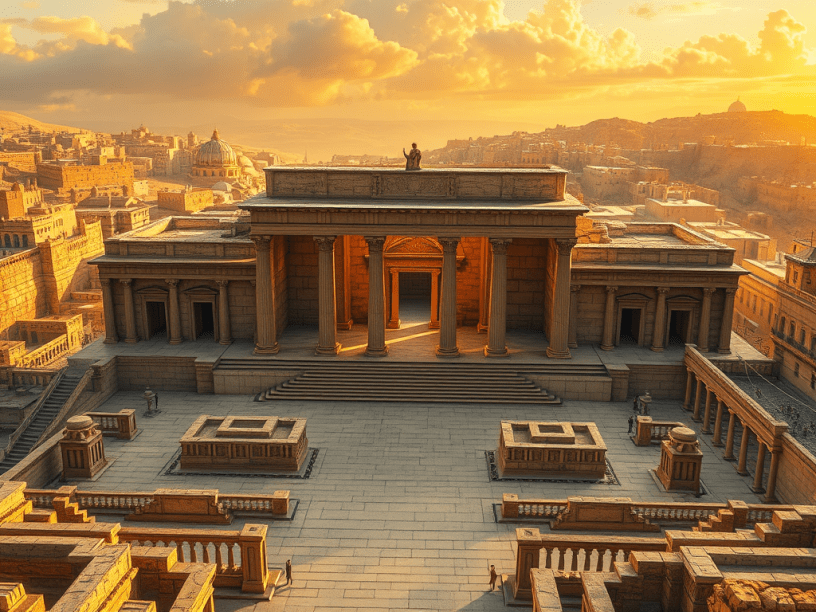
The Jewish Temple has played an important role in Judaism for thousands of years, but why is it important to Christians? Here’s a quick history lesson that may help us understand:
- Genesis 1 – 2: God created humans and desired to ‘dwell’ with them
- Exodus 29: God led the children of Israel out of Egypt so He could ‘dwell’ with them – “And they shall know that I am the Lord their God, who brought them up out of the land of Egypt, that I may dwell among them. I am the Lord their God.”
- Exodus 40: God instructed Moses how to build the Tabernacle, which is where God would ‘dwell’ with His people – “Then the cloud covered the tabernacle of meeting, and the glory of the Lord filled the tabernacle. And Moses was not able to enter the tabernacle of meeting, because the cloud rested above it, and the glory of the Lord filled the tabernacle. Whenever the cloud was taken up from above the tabernacle, the children of Israel would go onward in all their journeys. But if the cloud was not taken up, then they did not journey till the day that it was taken up. For the cloud of the Lord was above the tabernacle by day, and fire was over it by night, in the sight of all the house of Israel, throughout all their journeys.”
- Joshua 18: The children of Israel set up the Tabernacle in Shiloh where God would ‘dwell’ with them – “Now the whole congregation of the children of Israel assembled together at Shiloh, and set up the tabernacle of meeting there. And the land was subdued before them.”
- 1 Kings 6: King Solomon began to build the first Temple where God would ‘dwell’ with His people and completed it in seven years (approximately 957 BC) – “And it came to pass in the four hundred and eightieth year after the children of Israel had come out of the land of Egypt, in the fourth year of Solomon’s reign over Israel, in the month of Ziv, which is the second month, that he began to build the house of the Lord … In the fourth year the foundation of the house of the Lord was laid, in the month of Ziv. And in the eleventh year, in the month of Bul, which is the eighth month, the house was finished in all its details and according to all its plans. So he was seven years in building it.”
- 1 Kings 8: God moved from the Tabernacle to Solomon’s Temple that He might ‘dwell’ with His people – “And it came to pass, when the priests came out of the holy place, that the cloud filled the house of the Lord, so that the priests could not continue ministering because of the cloud; for the glory of the Lord filled the house of the Lord. Then Solomon spoke: ‘The Lord said He would dwell in the dark cloud. I have surely built You an exalted house, And a place for You to dwell in forever.”
- Ezekiel 10 and 2 Chronicles 36: God’s Glory left Solomon’s Temple just prior to the Babylonian Army destroying the building in 586 BC – “Then the glory of the Lord departed from the threshold of the temple and stood over the cherubim” … “And all the articles from the house of God, great and small, the treasures of the house of the Lord, and the treasures of the king and of his leaders, all these he took to Babylon. Then they burned the house of God, broke down the wall of Jerusalem, burned all its palaces with fire, and destroyed all its precious possessions. And those who escaped from the sword he carried away to Babylon, where they became servants to him and his sons until the rule of the kingdom of Persia, to fulfill the word of the Lord by the mouth of Jeremiah, until the land had enjoyed her Sabbaths. As long as she lay desolate she kept Sabbath, to fulfill seventy years.”
- Haggai 1 – 2: God instructed His people to build Him a new (second) Temple that He might ‘dwell’ with them’ (completed approximately 516 BC) – “Go up to the mountains and bring wood and build the temple, that I may take pleasure in it and be glorified,’ says the Lord” … “So the Lord stirred up the spirit of Zerubbabel the son of Shealtiel, governor of Judah, and the spirit of Joshua the son of Jehozadak, the high priest, and the spirit of all the remnant of the people; and they came and worked on the house of the Lord of hosts, their God, on the twenty-fourth day of the sixth month, in the second year of King Darius” … “For thus says the Lord of hosts: ‘Once more (it is a little while) I will shake heaven and earth, the sea and dry land; and I will shake all nations, and they shall come to the Desire of All Nations, and I will fill this temple with glory,’ says the Lord of hosts. ‘The silver is Mine, and the gold is Mine,’ says the Lord of hosts. ‘The glory of this latter temple shall be greater than the former,’ says the Lord of hosts. ‘And in this place I will give peace,’ says the Lord of hosts.”
- King Herod began renovating and expanding the Second Temple about 20 or 19 BC – The Jewish historian Josephus who lived during the 1st century AD gave 20 BC as the beginning of the renovation (Antiquities 15.380). Some scholars believe it was really 19 BC because of differences in calendrical systems. Herod the Great completed the Temple Sanctuary within about 18 months. The rest of the renovation took several decades. Josephus wrote in Antiquities 20.219 that the Temple complex work was completed under Herod Agrippa II, which would be somewhere around 63 or 64 AD. However, the completed Temple renovation and expansion was short-lived. General Titus and the Roman Army destroyed the Temple in 70 AD during the Jewish revolt. Titus became the Emperor of Rome several years later.
The Primary Point
That history brings us to the primary point of this study: the importance of the Jewish Temple in Christianity. The focus for our study is found in John chapter 2 –
“Now the Passover of the Jews was at hand, and Jesus went up to Jerusalem. And He found in the temple those who sold oxen and sheep and doves, and the money changers doing business. When He had made a whip of cords, He drove them all out of the temple, with the sheep and the oxen, and poured out the changers’ money and overturned the tables. And He said to those who sold doves, ‘Take these things away! Do not make My Father’s house a house of merchandise!’ Then His disciples remembered that it was written, ‘Zeal for Your house has eaten Me up.’ So the Jews answered and said to Him, ‘What sign do You show to us, since You do these things?’ Jesus answered and said to them, ‘Destroy this temple, and in three days I will raise it up.’ Then the Jews said, ‘It has taken forty-six years to build this temple, and will You raise it up in three days?’ But He was speaking of the temple of His body. Therefore, when He had risen from the dead, His disciples remembered that He had said this to them; and they believed the Scripture and the word which Jesus had said.”
Our key verse is John 2:20 – “Then the Jews said, ‘It has taken forty-six years to build this temple, and will You raise it up in three days?” Forty-six years from the beginning of the building of Herod’s Temple addition in 20 or 19 BC would mean that Jesus was speaking with the Jews in John 2 in 26 or 27 AD. That is two-thousand years ago. That’s the importance of the the Jewish Temple to Christianity.
God’s ‘ultimate goal’ has not changed. He wants to ‘dwell’ with His people .. and He will –
“Now, therefore, you are no longer strangers and foreigners, but fellow citizens with the saints and members of the household of God, having been built on the foundation of the apostles and prophets, Jesus Christ Himself being the chief cornerstone, in whom the whole building, being fitted together, grows into a holy temple in the Lord, in whom you also are being built together for a dwelling place of God in the Spirit.” Ephesians 2:19-22
“And I heard a loud voice from heaven saying, ‘Behold, the tabernacle of God is with men, and He will dwell with them, and they shall be His people. God Himself will be with them and be their God.” Revelation 21:3
Understanding John’s Timeline
According to the timeline in John’s Gospel, Jesus of Nazareth chose His disciples soon after His baptism (John 1). The second chapter of John begins with Jesus’ first miracle – turning water into wine.
“This beginning of signs Jesus did in Cana of Galilee, and manifested His glory; and His disciples believed in Him.” John 2:11
The next event John addressed was that of Jesus and His disciples traveling to Jerusalem when the “Passover of the Jews was at hand.” It was there that Jesus ‘cleansed’ the Temple of people who were defiling it. The disciples remembered the words of King David in Psalm 69:9 as they watched Jesus. The Jews who were at the Temple asked Jesus to show them a ‘sign,’ “since You do these things.” Jesus answered: “Destroy this temple, and in three days I will raise it up.” That led the Jews to ask Him, “It has taken forty-six years to build this temple, and will You raise it up in three days?” John wrote that Jesus “was speaking of the temple of His body.” The Lord’s disciples remembered what Jesus had said later. after He rose from the dead – “and they believed the Scripture and the word which Jesus had said.”
John’s Gospel recorded three or four Passovers during Jesus’ ministry, depending on your understanding of ancient history and the usage of the language. The multiple Passovers in John are how students of the New Testament determined that Jesus’ earthly ministry lasted between three and four years.
“Now the Passover of the Jews was at hand, and Jesus went up to Jerusalem.” John 2:13
“After this there was a feast of the Jews, and Jesus went up to Jerusalem.” John 5:1
“Now the Passover, a feast of the Jews, was near.” John 6:4
“And the Passover of the Jews was near, and many went from the country up to Jerusalem before the Passover, to purify themselves. John 11:55
The Passover mentioned in John 11 as being ‘near’ is when Jesus was crucified. The ‘feast of the Jews’ mentioned in John 5 is believed to be a Passover as well. Jews traveled to Jerusalem for the Feast of the Passover. Based on these verses I believe that John recorded a total of four Passovers during Jesus’ earthly ministry. That would mean Jesus was most likely crucified and rose from the dead in 29 or 30 AD –
- 26 or 27 AD – First Passover
- 27 or 28 AD – Second Passover
- 28 or 29 AD – Third Passover
- 29 or 30 AD – Fourth Passover and the Lord’s crucifixion, resurrection, and ascension
I tend to lean toward the 26 AD date for the first Passover based on Josephus’ historical record, though a year later would not cause a prophetic problem that I can see. We do know that Jesus was born to Mary while Herod the Great was still alive. Many historians believe Herod died between 4 BC and 1 BC, so that helps us know the date of Jesus’ birth.
Jesus was probably born between 4 BC and 2 BC based on what we learn about Herod trying to kill Him after talking with the ‘wise men from the East’ (Matthew 2). An angel warned Joseph and told him to take Jesus and Mary to Egypt to escape Herod’s murderous rage. Herod ordered the killing of “all the male children who were in Bethlehem and in all its districts, from two years old and under.” That detail helps us date the birth of Jesus pretty closely.
Herod died a short time after ordering the murder of the young male children in and near Bethlehem. An angel visited Joseph in Egypt through a dream and told him it was safe to return to Israel because Herod was dead. Joseph took Mary and Jesus to the small town of Nazareth in the region of Galilee – “that it might be fulfilled which was spoken by the prophets, ‘He shall be called a Nazarene.” That’s why Jesus grew up in Nazareth rather than Bethlehem.
Why Dates Matter
All of these dates matter to Christians because we know that we may have just entered into an extremely special time in God’s eternal plan. We are two thousand years from the beginning of Jesus’ earthly ministry. That means we are also within a few years of the two-thousandth anniversary of Jesus’ Crucifixion, Resurrection, and Ascension.
Moses wrote this in what we know as Psalm 90:4 –
“For a thousand years in Your sight Are like yesterday when it is past, And like a watch in the night.”
The Apostle Peter wrote this in the context of God’s ‘judgment and perdition of ungodly men’-
“But, beloved, do not forget this one thing, that with the Lord one day is as a thousand years, and a thousand years as one day.” 2 Peter 3:8
Peter also wrote –
“The Lord is not slack concerning His promise, as some count slackness, but is longsuffering toward us, not willing that any should perish but that all should come to repentance. But the day of the Lord will come as a thief in the night …” 2 Peter 3:9-10a
Christians should always be looking for the coming of the Lord. Jesus made that clear to His disciples through His teaching, and the apostles made that clear through their teaching which was inspired by the Spirit of God.
“Therefore, beloved, looking forward to these things, be diligent to be found by Him in peace, without spot and blameless; and consider that the longsuffering of our Lord is salvation—as also our beloved brother Paul, according to the wisdom given to him, has written to you, as also in all his epistles, speaking in them of these things, in which are some things hard to understand, which untaught and unstable people twist to their own destruction, as they do also the rest of the Scriptures.” 2 Peter 3:14-16
Only God knows when He will send Jesus to gather together His elect (1 Thessalonians 4 and 1 Corinthians 15), then return to Jerusalem to establish His earthly Kingdom. I am not a ‘date-setter’ for these events. However, I do what Jesus told His disciples to do – “Watch therefore, for you do not know what hour your Lord is coming.” We also get an insight to ‘how to watch’ spiritually from what Jesus said to the Jewish elite –
“Then the Pharisees and Sadducees came, and testing Him asked that He would show them a sign from heaven. He answered and said to them, ‘When it is evening you say, ‘It will be fair weather, for the sky is red’; and in the morning, ‘It will be foul weather today, for the sky is red and threatening.’ Hypocrites! You know how to discern the face of the sky, but you cannot discern the signs of the times.” Matthew 16:1-3
Christians should not set dates for the return of Christ, but they should watch and discern the signs of the times. I’ll leave you with these words from Jesus in answer to His disciples’ question about what would the sign be of His coming and the ‘end of the age’ –
“But as the days of Noah were, so also will the coming of the Son of Man be. For as in the days before the flood, they were eating and drinking, marrying and giving in marriage, until the day that Noah entered the ark, and did not know until the flood came and took them all away, so also will the coming of the Son of Man be.” Matthew 24:37-39
Are you watching? Are you discerning the times? Whether Jesus returns in the next four years or four hundred years, may members of His Body do His will and preach His Gospel.
[Jews have not had a Temple in Jerusalem for worship or sacrifice for more than 19-hundred-and-fifty years. However, that does not mean a Temple does not exist now nor that another Temple will be built in Jerusalem in the future. I’ll write about those Temples in a future study.]
Scripture taken from the New King James Version®. Copyright © 1982 by Thomas Nelson. Used by permission. All rights reserved.
GraceLife © 1990-2026

 GraceLife Blog