
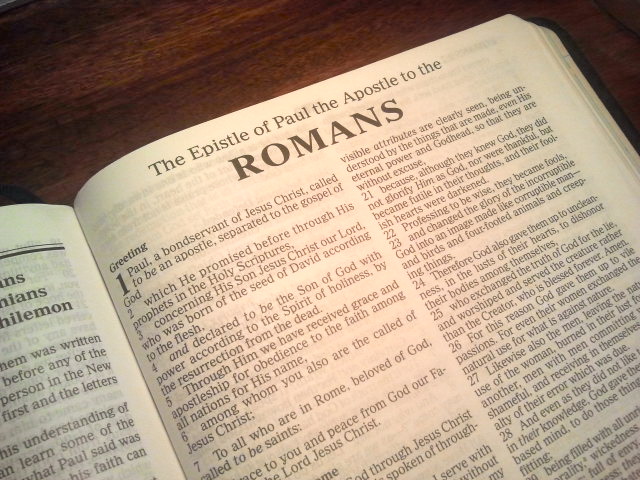
The New King James Bible divides Romans chapter 7 into three parts:
- Freed from the Law: 1-6
- Sin’s Advantage in the Law: 7-12
- Law Cannot Save from Sin: 13-25
Today’s study is from verses 15-16.
Verses 15-16
For what I am doing, I do not understand. For what I will to do, that I do not practice; but what I hate, that I do. If, then, I do what I will not to do, I agree with the law that it is good.
ο γαρ κατεργαζομαι ου γινωσκω ου γαρ ο θελω τουτο πρασσω αλλ ο μισω τουτο ποιω ει δε ο ου θελω τουτο ποιω συμφημι τω νομω οτι καλος
ο γαρ κατεργαζομαι ου γινωσκω (ho far katergazomai ou ginōskō) “what for I do not I understand” … the word “doing” comes from katergazomai … it is a verb that means “to work out, bring about, perform, carry out” … it is present indicative middle or passive … Paul uses this statement in the context of spiritual slavery – “For we know that the law is spiritual, but I am carnal, sold under sin” (vs. 14) … Paul is saying that he does not “understand” what he “does” or is “doing” … the word “understand” comes from ginōskō – “to come to know, perceive, recognize, realize” … the word speaks specifically to a knowledge or an understanding that comes from “experience” … based on other writings of Paul where he declares that he “knows” and “understands” what he is doing in living for Christ, Romans 7:15 raises some questions for proper interpretation …
ου γαρ ο θελω τουτο πρασσω (ou gar ho thelō touto prassō) “not for what I want this I do” … the verb thelō means “wish, desire, will, want, intent” … prassō means “to do, practice, perform, accomplish … it is in the present indicative active … this is the other side of not understanding what he does do because he does those things that he does not want to do …
αλλ ο μισω τουτο ποιω (all ho misō touto poiō) “but what I hate this I do” … the word misō means “detest, hate” … Paul chose to use another strong comparative word … he hated, detested what he did … he did not do what he wanted to do, but did what he didn’t want to do …
Here the “willing” and the “hating,” if carefully weighed, are good evidence for the reference of this whole section to the regenerate soul in its conflicts. It is certainly out of harmony with St Paul’s doctrine of grace to represent the soul, before special grace, as “hating” sin as sin, and “willing” pure holiness as holiness.—On the whole passage we must again remember that a soul fully alive to the profound sanctity of the Law is in view. Not gross but minute deviations (minute on the human standard) occasion these complaints. Cambridge Bible for Schools and Colleges
… it is in fact the experience of all Christians. The habitual, fixed inclination and desire of their minds is to serve God. They have a fixed abhorrence of sin; and yet they are conscious of imperfection, and error, and sin, that is the source of uneasiness and trouble. The strength of natural passion may in an unguarded moment overcome them. The power of long habits of previous thoughts may annoy them. A man who was an infidel before his conversion, and whose mind was filled with scepticism, and cavils, and blasphemy, will find the effect of his former habits of thinking lingering in his mind, and annoying his peace for years. These thoughts will start up with the rapidity of lightning. Thus, it is with every vice and every opinion. It is one of the effects of habit. “The very passage of an impure thought through the mind leaves pollution behind it,” and where sin has been long indulged, it leaves its withering, desolating effect on the soul long after conversion, and produces that state of conflict with which every Christian is familiar. Barnes’ Notes on the Bible
Now, Paul explains his situation. ‘Allow’ is ginóskó, ‘to know by experience, to understand.’ He says, ‘For that which I do, I do not understand.’ He does not understand his experience as a Christian. He says, ‘For that which I desire, this I do not practice, but that which I hate, this I am doing.’ That is, the very thing he desires to do, namely, good, this he does not do, and that which he hates, this is the thing he does do. It is clear that Paul is recounting his experience as a saved man. He desires to do good and hates sin. No unsaved man does that. The failure to achieve his purpose is found in the fact that he is attempting in his own strength that which can only be accomplished in the supernatural power of the Holy Spirit. Word Studies in the Greek New Testament, Kenneth Wuest
συμφημι τω νομω οτι καλος (sumphēmi tō nomō hoti kalos) “I consent to the law that it is good” .. sumphēmi means “agree with, confess, assent to, consent” .. what Paul is agreeing with here is that the Mosaic Law is “good” .. keep in mind that Paul has earlier made the argument that no one is “saved” by the Law, so how can it be good? The Law is good because it is God’s Law. God spoke the Law and Moses wrote it down for Israel and the entire world to read. The Law takes us to our knees as we see the holiness of God, how in need we are of His spiritual help, and the wonderful ways in which He helps us.
Other Commentators
In doing what he hates, i.e., in doing evil against his will, his will agrees with the law, that it is good. καλός suggests the moral beauty or nobility of the law, not like ἀγαθή (Romans 7:12) its beneficial purpose. Expositor’s Greek Testament
But the fact that I desire to do what is right is itself a witness to the excellence of the Law, which commands that which I desire. Ellicott’s Commentary for English Readers
If then, &c.] The emphasis is obviously on ‘that which I would not:’ q. d., ‘If my faulty course of action is contradicted by my will, I thereby consent to the goodness of the Law, which also contradicts it.’ Cambridge Bible for Schools and Colleges
This very thing is an argument, that the law is such as I have before asserted, Romans 7:12,14. This shows my consent to the holiness and goodness of the law; I vote with it, and for it, as the only rule of right or righteousness. Matthew Poole’s Commentary
consented to the law, that it was good; lovely and amiable; that it forbad those things which were hateful, and commanded those things which were desirable to a good man; and so is acknowledged to be a very beautiful rule of obedience, walk, and conversation. Gill’s Exposition of the Entire Bible
7:15 understand. This refers to knowledge that goes beyond the factual and invkluces the idea of an intimate relationship (cf. Gal. 4:9). By extension, this word was sometimes used to express approving or accepting (cf. 1 Cor. 8:3). That is its sense here, i.e., Paul found himself doing things he did not approve of. 7:16 I agree with the law that it is good. Paul’s new nature defends the divine standard – the perfectly righteous law is not responsible for his sin (v. 12). His new self longs to honor the law and keep it perfectly (v. 22). The MacArthur Study Bible, 2nd Edition, Thomas Nelson
Romans Resources
Commentary on Romans “The Gospel of God” Chapter 1 Verses 1-15
Commentary on Romans “The Gospel of God” Chapter 1 Verses 16-17
Commentary on Romans “The Gospel of God” Chapter 1:18 – 25
Commentary on Romans “The Gospel of God” Chapter 1:25-32
Commentary on Romans “The Gospel of God” Chapter 2:1-29
Commentary on Romans “The Gospel of God” Chapter 3
Commentary on Romans “The Gospel of God”Chapter 4
Commentary on Romans “The Gospel of God” Chapter 5
Commentary on Romans “The Gospel of God” Chapter 6
Next Time
We will look at Romans 7:17-20 in the next part of our study of the Gospel of God.
Scripture taken from the New King James Version®. Copyright © 1982 by Thomas Nelson. Used by permission. All rights reserved.
GraceLife © 1990-2026

 GraceLife Blog