
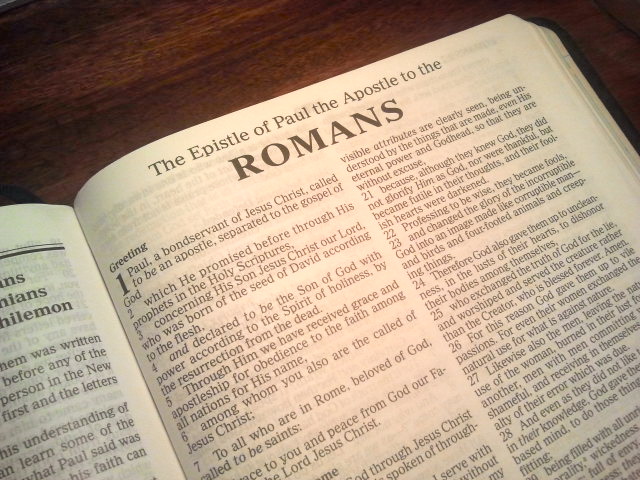
Welcome to the 100th edition of Romans – The Gospel of God! We started this series on July 14, 2012 with these words:
The Book of Romans is the “mountain peak” of the Apostle Paul’s inspired Writings. This great Book demonstrates the Power of God over sin and the astonishing efficacy of His Grace. Romans is Paul’s triumphant exposition about the truly amazing Grace of our Lord and Savior Jesus Christ. It is through Romans that we learn about the sinfulness of sin and the Righteousness of God. We learn about the wrath of God revealed from Heaven against all sin. Paul writes about the extreme penalty for sin for all members of the human race and the extreme payment for sin by God’s Son, Jesus Christ. It is in Romans that we see the horror of sin and the honor of the sinless Sacrifice of Jesus on the Cross. God is the Judge of sin. Jesus is the Propitiation for that sin. We learn through Romans that God frees sinning slaves to become forgiven saints. God is Sovereign in all the universe and the Source of all Truth.
My hope and prayer is that you have found these studies helpful in your own understanding of Paul’s great Letter to the Romans. The last part of our series was from Romans 7:11-12. We move now to verses 13-14.
Quick Review
As a quick review, remember that Paul had been addressing the fact that the Christians in Rome, Jews and Gentiles, had been freed from the Mosaic Law, along with the advantage that sin had in the Law. I summed up the last two verses (11-12) this way:
God gave His Law, with specific commandments, to His people. That law is holy because the great God who gave it is Holy. The commandments are holy and righteous and good. God’s Law is perfect and shines a holy light on our sinful nature. It guides us to Jesus Christ as the only God/Man who is holy, righteous, and good. It is only through the holiness of Christ that we can be saved and live in ways that please God.
The Apostle Paul used a question-answer technique in Romans that is a good example for us today as we talk with both believers and non-believers. Paul’s approach in Romans was within a letter, so he was asking and answering questions based on his understanding of what Jews and Gentiles believed and what they needed to know. We could use the technique in both a letter and talking with someone. It’s important to think about what other people believe and address them with questions that lead them to consider the truth of God’s Word.
The statement Paul made in verse 12 references back to the question he asked in verse 7: “What shall we say then? Is the law sin?” The answer is obvious: “Certainly not! On the contrary, I would not have known sin except through the law.” Paul is slowly and carefully working his way through the faulty thinking among some in the church in Rome. He does that by asking and answering questions that shed a bright light on their incorrect beliefs about a number of spiritual topics.
Here’s the next question in verse 13: “Has then what is good become death to me?” Paul is still looking at the effect of the question he posed in verse 7. Let see how Paul answered this one.
Verses 13-14
Has then what is good become death to me? Certainly not! But sin, that it might appear sin, was producing death in me through what is good, so that sin through the commandment might become exceedingly sinful. For we know that the law is spiritual, but I am carnal, sold under sin.
το ουν αγαθον εμοι γεγονεν θανατος μη γενοιτο αλλα η αμαρτια ινα φανη αμαρτια δια του αγαθου μοι κατεργαζομενη θανατον ινα γενηται καθ υπερβολην αμαρτωλος η αμαρτια δια της εντολης οιδαμεν γαρ οτι ο νομος πνευματικος εστιν εγω δε σαρκικος ειμι πεπραμενος υπο την αμαρτιαν
There were then, and still are, many people who believe that obedience to the Mosaic Law can save a person from sin. Remember that Paul just claimed in the previous verse (12) that “the law is holy, and the commandment holy and just and good.” If that is true, and it is, then why can’t obedience to the Law save us from sin? Good question. Let’s look deeper into Paul’s response.
First, the question: Has then what is good become death to me? Let’s look at the Greek:
το ουν αγαθον εμοι γεγονεν θανατος (to oun agathon emoi gegonen thanatos) “that which then is good to me has become death?” .. the word agathon means “intrinsically, inherently good” .. gegonen means “to come into being, come about, produce, to emerge” .. thanatos is used for both physical and spiritual death ..
The Law of God (Mosaic Law) is inherently good. Remember verse 12 because that’s the context. Paul was asking if the Law of God, which is good, had become death. His answer? Certainly not! μη γενοιτο (mē genoito) “never may it be!” The good Law of God did not become “death” to Paul. Then what did?
αλλα η αμαρτια ινα φανη αμαρτια δια του αγαθου μοι κατεργαζομενη θανατον (alla hē hamartia hina phanē harmatia dia tou agathou moi katergazomenē thanaton) “but sin in order that it might be shown to be sin through that which is good to me is working out death” ..
Sin (hamartia) means “failure, missing the mark, no part of, no share of because of missing the target.” In order for sin to be shown (phanē – to cause to appear, become visible, become clear, to bring to light, to shine) to be sin, God gave His good Law. Paul wrote the Galatian Christians this question: What purpose then does the law serve?” His answer: “It was added because of transgressions .. the Scripture has confined all under sin” (Galatians 3:19, 22). We know that we’re sinners before God because of His Law. Sin is what separates us from God. The Law teaches us that we are separated from God by sin: “the law was our tutor to bring us to Christ, that we might be justified by faith” (Galatians 3:24).
Sin is deadly. How do we know? Because the Law tells us it is deadly. It is working out death to those who have not been freed from its work. The Law is our teacher to lead us to Christ as the only solution to our problem with sin – “that we might be justified by faith.”
ινα γενηται καθ υπερβολην αμαρτωλος η αμαρτια δια της εντολης (hina genētai kath huperbolēn hamartōlos hē hamartia dia tēs entolēs) “so that might become beyond excess sinful sin through the commandment” .. huperbolēn means “beyond measure, exceedingly, excess” .. hamartōlos means “depraved, detestable, forfeit/loss from falling short, sinful” .. humans suffered great loss because of sin .. they fell short of what God demands .. this hearkens back to what Paul wrote earlier in Romans – “for all have sinned and fall short of the glory of God” (Romans 3:23) .. entolēs means “command, order” and focuses on the end result of a command ..
The first command of God to humans was this – “And the Lord God commanded the man, saying, ‘Of every tree of the garden you may freely eat; but of the tree of the knowledge of good and evil you shall not eat, for in the day that you eat of it you shall surely die.” (Genesis 2:16-17) “Surely die” meant more than just physical death for humans. It means they would find themselves separated from God and die spiritually. Adam and Eve suffered a GREAT LOSS that continues to infect and affect the human race to this day.
God has added many more commandments since those early days in the Garden of Eden. We them stated powerfully and clearly in the Mosaic Law. We die because of sin. The Law was added to show us how sinful we are in God’s sight. The more we know and understand God’s holy Law, the more we understand the sinfulness of sin and how it kills. “But sin, that it might appear sin, was producing death in me through what is good, so that sin through the commandment might become exceedingly sinful.”
V. 14
For we know that the law is spiritual, but I am carnal, sold under sin.
οιδαμεν γαρ οτι ο νομος πνευματικος εστιν εγω δε σαρκικος ειμι πεπραμενος υπο την αμαρτιαν
οιδαμεν γαρ οτι ο νομος πνευματικος εστιν (oidamen gar hoti ho nomos pneumatikos estin) “we know for that the law spiritual is” .. oidamen means “behold, be aware, perceive, consider, remember” .. the word was used for both physical sight awareness and spiritual awareness .. it is a knowledge (know) that comes from seeing and understanding .. pneumatikos means “spiritual, relating to the realm of the spirit” .. Christians should know that the Law of God is “spiritual” .. God’s law is supernatural, from the realm of the spirit world ..
εγω δε σαρκικος ειμι πεπραμενος υπο την αμαρτιαν (egō de sarkikos eimi pepramenos hupo tēn harmartian) “I however fleshly am having been sold under sin” .. sarkikos means “pertaining to the flesh, having the nature of flesh .. pepramenos means “to sell, slave to, devoted to” .. it comes from pernémi (to export for sale) .. hupo means “under, under the authority of” .. harmartian means “missing the mark, failure, loss from not hitting the mark” ..
Paul knew that the Law of God was spiritual, but he was carnal .. he was “sold under sin” .. Paul had been a Pharisee, he knew the Law .. Paul knew that the Mosaic Law was spiritual, but he came to understand that his human nature was carnal and that he had been sold under the authority of sin ..
That was important for the Christians in Rome to understand almost two-thousand years ago, and it’s important for us to understand today. The big question asked by Christians for centuries is whether Paul was referring to his life before salvation or before “and” after. We’ll look for answers to that in the next part of our study.
Other Commentaries
By the very way he accuses sin, Paul shows how excellent the law is….It was the commandment which showed us just how evil is. At the same time, Paul also shows how grace is so much greater than the law. Grace is not in conflict with the law; it is superior to it. Chrysostom, Homilies on Romans (Ancient Christian Commentary On Scripture, Romans, IVP)
Here Paul elaborates on what he said [in verse 8]. It is not that a good thing (i.e., the law) had become death for him but rather that sin worked death through the law’s goodness, i.e., that it became apparent whereas without the law it had lain hidden. For everyone recognizes that he is dead if he cannot fulfill a precept which he recognizes as just, and because of the criminal offense of the trespass he sins even more than he would have if it had not been forbidden. Before the coming of the law the offense was less, because without the law there is no transgression. Augustine On Romans (Ancient Christian Commentary On Scripture, Romans, IVP)
Was it possible that the Law, holy and good as it was, could simply lead miserable men to death and ruin? No, it was not possible. It was not the Law that did this but Sin—acting, it is true, through the instrumentality of the Law. All this, however, only had for its end to show up Sin for the monster that it really is. Ellicott’s Commentary for English Readers
Paul has hardly begun, in Romans 7:12, his exposition of the result of Romans 7:7-11, when his train of thought is again crossed by an inference that might possibly be drawn from what had just been said, and used against him (comp. Romans 7:7). He puts this inference as a question, and now gives in the form of a refutation of it what he had intended to give, according to the plan begun in Romans 7:12, not in polemical form, but in a sentence with δέ that should correspond to the sentence with μέν. Meyer’s NT Commentary
Was then that which is good … – This is another objection which the apostle proceeds to answer. The objection is this, “Can it be possible that what is admitted to be good and pure, should be changed into evil? Can what tends to life, be made death to a man?” In answer to this, the apostle repeats that the fault was not in the Law, but was in himself, and in his sinful propensities. Barnes’ Notes on the Bible
Denny explains; “The description of the commandment as ‘good’ raises the problem of verse 7 in a new form. Can the good issue in evil? Did that which is good turn out to be death to me? This also is denied, or rather repelled. It was not the good law, but sin, which became death to the apostle. And in this there was a divine intention, namely, that sin might appear sin, might come out in its true colors, by working death for man through that which is good. Sin turns God’s intended blessing into a curse; nothing could more clearly show what it is, or excite a stronger desire for deliverance from it.” Robertson comments; “The excesses of sin reveal its real nature. Only then do some people get their eyes opened.” Kenneth Wuest, Romans in the Greek New Testament, Wm. B. Eerdmans Publishing Co., 1955
Romans Resources
Commentary on Romans “The Gospel of God” Chapter 1 Verses 1-15
Commentary on Romans “The Gospel of God” Chapter 1 Verses 16-17
Commentary on Romans “The Gospel of God” Chapter 1:18 – 25
Commentary on Romans “The Gospel of God” Chapter 1:25-32
Commentary on Romans “The Gospel of God” Chapter 2:1-29
Commentary on Romans “The Gospel of God” Chapter 3
Commentary on Romans “The Gospel of God”Chapter 4
Commentary on Romans “The Gospel of God” Chapter 5
Commentary on Romans “The Gospel of God” Chapter 6
Next Time
We will look at Romans 7:15-16 in the next part of our study of the Gospel of God.
Scripture taken from the New King James Version®. Copyright © 1982 by Thomas Nelson. Used by permission. All rights reserved.
GraceLife © 1990-2025

 GraceLife Blog