
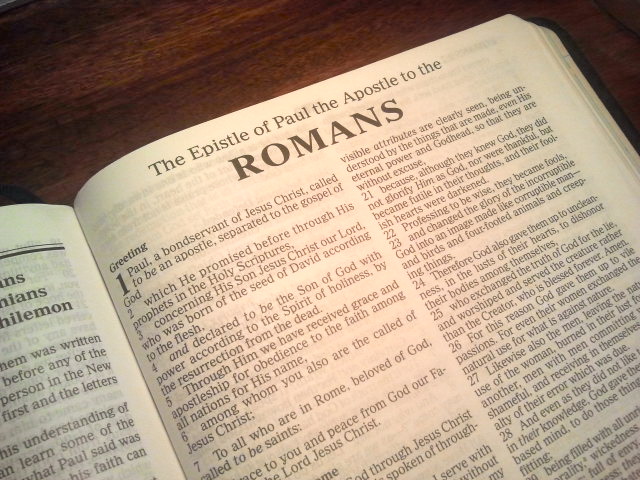
Our continuing study into Romans chapter 7 is part of a section where Paul emphasized the fact that the Mosaic Law cannot save anyone from sin. We looked at verses 15 and 16 in the last part of our study. We move now to verses 17 – 20.
Verses 17 – 20
But now, it is no longer I who do it, but sin that dwells in me. For I know that in me (that is, in my flesh) nothing good dwells; for to will is present with me, but how to perform what is good I do not find. For the good that I will to do, I do not do; but the evil I will not to do, that I practice. Now if I do what I will not to do, it is no longer I who do it, but sin that dwells in me.
νυνι δε ουκετι εγω κατεργαζομαι αυτο αλλ η οικουσα εν εμοι αμαρτια οιδα γαρ οτι ουκ οικει εν εμοι τουτεστιν εν τη σαρκι μου αγαθον το γαρ θελειν παρακειται μοι το δε κατεργαζεσθαι το καλον ουχ ευρισκω ου γαρ ο θελω ποιω αγαθον αλλ ο ου θελω κακον τουτο πρασσω ει δε ο ου θελω εγω τουτο ποιω ουκετι εγω κατεργαζομαι αυτο αλλ η οικουσα εν εμοι αμαρτια
In the preceding verses the Apostle Paul began explaining how the Law that was so important to Jews was not able to save them. He wrote that ‘sin, that it might appear sin, was producing death in me through what is good, so that sin through the commandment might become exceedingly sinful.’ That was certainly not how Jews understood the Law. Paul continued – ‘For we know that the law is spiritual, but I am carnal, sold under sin. For what I am doing, I do not understand. For what I will to do, that I do not practice; but what I hate, that I do. If, then, I do what I will not to do, I agree with the law that it is good.’ Again, an unusual thing for a Jew to say.
What was Paul’s point? He makes it in the next verses –
Verse 17
But now, it is no longer I who do it, but sin that dwells in me.
νυνι δε ουκετι εγω κατεργαζομαι αυτο αλλ η οικουσα εν εμοι αμαρτια
I want to first acknowledge that some theologians believe Paul was addressing his life ‘before’ becoming a follower of Jesus Christ. Other theologians believe Paul was addressing his life as it was at the time of his writing (after his conversion). I believe Paul was writing about his current condition after conversion, but I have read the ‘other’ perspectives and understand their arguments. However, I am not convinced they are correct. With that being said, let’s look at the verse and see what we can learn from the Greek.
νυνι δε (nuni de) “in that case now” … Paul used a phrase containing an adverb and conjunction that seems to denote the idea of something occurring ‘now’ in his life – at the ‘present time.’
Paul stated in the preceding verse that by ‘not doing’ what the Law said proved that he agreed that the Law ‘is good.’ The Law is good when we understand why God gave it to Israel. As Paul wrote to the Galatians –
But before faith came, we were kept under guard by the law, kept for the faith which would afterward be revealed. Therefore the law was our tutor to bring us to Christ, that we might be justified by faith. But after faith has come, we are no longer under a tutor.’ Galatians 3:23-25
Paul understood the goodness of the Law in that it was our ‘tutor,’ our ‘teacher, instructor,’ to ‘bring us to Christ, that we might be justified by faith.’ What happened after ‘faith has come?’ We are ‘no longer under a tutor,’ which in the context was the Law.
The Law has its place and it is important for us to remember that the Holy Spirit uses the Law to ‘convict the world of sin, and of righteousness, and of judgment’ (John 16:8). However, keeping people ‘under the Law’ was not and is not God’s intention. As the Apostle John wrote in his Gospel account – ‘For the law was given through Moses, but grace and truth came through Jesus Christ’ (John 1:17). Keeping people ‘under the Law’ after Jesus came to earth, died, rose from the dead, and ascended back to Heaven is counterproductive. That is a primary theme of Paul’s letter to the Galatians.
The Law ‘was our tutor to bring us to Christ, that we might be justified by faith.’ Faith is how God saves. The Law is how God shows us that we must repent of our sins and ‘believe in the Lord Jesus Christ.’ What happens after a person repents of their sins and believes in Jesus Christ? They are ‘no longer under a tutor.’
As for the word ‘now,’ let’s turn to Dr. Marvin Vincent for some insight – ‘Not temporal, pointing back to a time when it was otherwise, but logical, pointing to an inference. After this statement you can no more maintain that, etc.’ (Vincent, Word Studies in the New Testament, 1887)
ουκετι εγω κατεργαζομαι αυτο (outketi egō katergazomai auto) “no longer I am doing it” … katergazomai is important to note is a ‘present tense’ verb. It is ‘present indicative middle’ (or passive). Paul was not referring to something he ‘did’ before his conversion, but something he was doing at the time of his writing to the Romans. However, he does say that he was no longer ‘doing it.’ Then what was causing the problem?
Remember the context – ‘For we know that the law is spiritual, but I am carnal, sold under sin. For what I am doing, I do not understand. For what I will to do, that I do not practice; but what I hate, that I do. If, then, I do what I will not to do, I agree with the law that it is good.’
αλλ η οικουσα εν εμοι αμαρτια (alla hē oikousa en emoi hamartia) ‘but the dwelling in me sin’ … oikousa is also a present tense verb (present tense participle) .. Paul said he didn’t understand what what he was doing (vs. 15). He didn’t practice what he wanted to do, but did what he hated. Why? This is key –
But now, it is no longer I who do it, but sin that dwells in me.
Faith in Jesus changed Paul spiritual position (darkness into light), but it did not remove the sin that ‘dwells’ in him. That’s why Christians have the struggles they do. They sin, they make bad choices, they do the things they don’t want to do and do the things they don’t want to do. Join the club is what Paul is saying.
Question. If God saves us from ‘sin,’ why do we still have it in us? Where does it live?
Verse 18
For I know that in me (that is, in my flesh) nothing good dwells; for to will is present with me, but how to perform what is good I do not find.
οιδα γαρ οτι ουκ οικει εν εμοι τουτεστιν εν τη σαρκι μου αγαθον το γαρ θελειν παρακειται μοι το δε κατεργαζεσθαι το καλον ουχ ευρισκω
οιδα γαρ οτι ουκ οικει εν εμοι (oida gar oti ouk oikei en emoi) “I know for that nothing there dwells in me” … oikei (dwells) is again a present tense verb (present indicative active) .. where did sin ‘dwell’ in Paul?
τουτεστιν εν τη σαρκι μου (toutestin en tē sarki mou to) ‘that is in the flesh of me’ … sarki means ‘flesh’ .. the idea of the word ‘flesh’ to the Greeks meant the ‘body, human nature.’ That’s where sin dwelled in Paul and where it dwells in Christians today .. in our body, in our human nature. We have both a spiritual ‘nature’ and a ‘fleshly’ nature. That’s one reason why Christians, true Christians (really saved, not just pretending), struggle with sin. It’s still part of their ‘human nature.’
αγαθον το γαρ θελειν παρακειται μοι (agathon to gar thelein parakeitai) ‘good for to will is present with me’ … parakeitai is another present tense verb (present indicative middle or passive) .. Paul had the ‘will’ (thelein), the ‘desire’ to do good, but ..
δε κατεργαζεσθαι το καλον ουχ ευρισκω (de katergazesthai to kalon ouch eurisko) ‘but to do the good not’ … katergazesthai (to do, work out, achieve, perform, bring about, work down to the end point) is another present tense verb (present infinitive middle or passive) .. Paul had the will to do good, but (as the NKJV translates) ‘how to perform what is good I do not find.’
Verse 19
For the good that I will to do, I do not do; but the evil I will not to do, that I practice.
ου γαρ ο θελω ποιω αγαθον αλλ ο ου θελω κακον τουτο πρασσω
ου γαρ ο θελω ποιω αγαθον (ou gar ho thelō poiō agathon) ‘not for that I desire I do good’ … thelō is a present tense verb (present indicative active) and means ‘to will, to desire’ .. poiō is a present tense verb (present indicative active) and means ‘to make, manufacture, cause, do’ ..
αλλ ο ου θελω κακον (alla ho ou thelō kakon) ‘but that not I do want evil’ … kakon means ‘bad, foul, rotten, evil in the widest sense’ .. we don’t often think of Christians having a foul or rotten side to them, until they say or do something that makes you think ‘what a foul thing to say’ or ‘what a rotten thing to do.’ It happened to Paul .. it happens to us.
τουτο πρασσω (touto prassō) ‘this I practice’ … prassō means ‘the active process in performing, accomplishing’ .. the word implies a ‘regular or routine practice’ .. this battle that resided inside Paul’s flesh, and resides in ours, causes us to struggle with fleshly sin regularly, routinely
Verse 20
Now if I do what I will not to do, it is no longer I who do it, but sin that dwells in me.
ει δε ο ου θελω εγω τουτο ποιω ουκετι εγω κατεργαζομαι αυτο αλλ η οικουσα εν εμοι αμαρτια
ει δε ο ου θελω (ei de ho ou thelō) ‘if now what not I do want’ … thelō is a present tense verb (present indicative active) ..
εγω τουτο ποιω (egō touto poiō) ‘I this do’ … poiō is a present tense verb (present indicative active) ..
ουκετι εγω κατεργαζομαι αυτο (ouketi egō katergazomai auto) ‘it is no longer I who do it’ … katergazomai is a present tense verb (present indicative middle or passive) .. Paul said it was not his saved ‘ego’, but ..
αλλ η οικουσα εν εμοι αμαρτια (alla hē oikousa en emoi hamartia) ‘but dwelling in me sin’ … oikousa is a present tense verb (present participle active) .. hamartia is ‘sin, missing the mark, fault, sinful deed) ..
I pointed out that all of the verbs Paul used are ‘present tense’ to help support the interpretation that he was writing about a current struggle that he and all believers have. We need God’s Holy Spirit to help us battle with the flesh. Paul wrote about that in some detail a few years earlier in his letter to the Galatians –
I say then: Walk in the Spirit, and you shall not fulfill the lust of the flesh. For the flesh lusts against the Spirit, and the Spirit against the flesh; and these are contrary to one another, so that you do not do the things that you wish. But if you are led by the Spirit, you are not under the law. Galatians 5:16-18
Paul made it clear in Galatians that Christians ‘do not do the things’ that they want. Why? Because the ‘flesh’ lusts against the Spirit, and the Spirit ‘against the flesh.’ Interestingly, all of the verbs used in that section of Galatians are present tense. It’s a battle that rages in us right now! We need God’s help to fight this battle until Jesus comes to take us ‘home’ where ‘this corruptible must put on incorruption, and this mortal must put on immortality’ ..
So when this corruptible has put on incorruption, and this mortal has put on immortality, then shall be brought to pass the saying that is written: ‘Death is swallowed up in victory. 1 Corinthians 15:53
Other Interpretations
Compared with the holy rule of conduct in the law of God, the apostle found himself so very far short of perfection, that he seemed to be carnal; like a man who is sold against his will to a hated master, from whom he cannot set himself at liberty. A real Christian unwillingly serves this hated master, yet cannot shake off the galling chain, till his powerful and gracious Friend above, rescues him. The remaining evil of his heart is a real and humbling hinderance to his serving God as angels do and the spirits of just made perfect. This strong language was the result of St. Paul’s great advance in holiness, and the depth of his self-abasement and hatred of sin. If we do not understand this language, it is because we are so far beneath him in holiness, knowledge of the spirituality of God’s law, and the evil of our own hearts, and hatred of moral evil. And many believers have adopted the apostle’s language, showing that it is suitable to their deep feelings of abhorrence of sin, and self-abasement. The apostle enlarges on the conflict he daily maintained with the remainder of his original depravity. He was frequently led into tempers, words, or actions, which he did not approve or allow in his renewed judgement and affections. By distinguishing his real self, his spiritual part, from the self, or flesh, in which sin dwelt, and by observing that the evil actions were done, not by him, but by sin dwelling in him, the apostle did not mean that men are not accountable for their sins, but he teaches the evil of their sins, by showing that they are all done against reason and conscience. Sin dwelling in a man, does not prove its ruling, or having dominion over him. If a man dwells in a city, or in a country, still he may not rule there. Matthew Henry’s Concise Commentary
It is no more I that do it – This is evidently figurative language, for it is really the man that sins when evil is committed. But the apostle makes a distinction between sin and what he intends by the pronoun “I”. By the former he evidently means his corrupt nature. By the latter he refers to his renewed nature, his Christian principles. He means to say that he does not approve or love it in his present state, but that it is the result of his native propensities and passions. In his heart, and conscience, and habitual feeling, he did not choose to commit sin, but abhorred it. Thus, every Christian can say that he does not choose to do evil, but would wish to be perfect; that he hates sin, and yet that his corrupt passions lead him astray. Barnes’ Notes on the Bible
7:18 in me…nothing good dwells. The flesh serves as a base camp from which sin operates in the Christian’s life. It is not sinful inherently, but because of its fallenness, it is still subject to sin and is thoroughly contaminated. The MacArthur Study Bible
Romans Resources
Commentary on Romans “The Gospel of God” Chapter 1 Verses 1-15
Commentary on Romans “The Gospel of God” Chapter 1 Verses 16-17
Commentary on Romans “The Gospel of God” Chapter 1:18 – 25
Commentary on Romans “The Gospel of God” Chapter 1:25-32
Commentary on Romans “The Gospel of God” Chapter 2:1-29
Commentary on Romans “The Gospel of God” Chapter 3
Commentary on Romans “The Gospel of God”Chapter 4
Commentary on Romans “The Gospel of God” Chapter 5
Commentary on Romans “The Gospel of God” Chapter 6
Next Time
We will look at Romans 7:21-25 in the next part of our study of the Gospel of God.
Scripture taken from the New King James Version®. Copyright © 1982 by Thomas Nelson. Used by permission. All rights reserved.
GraceLife © 1990-2026


