
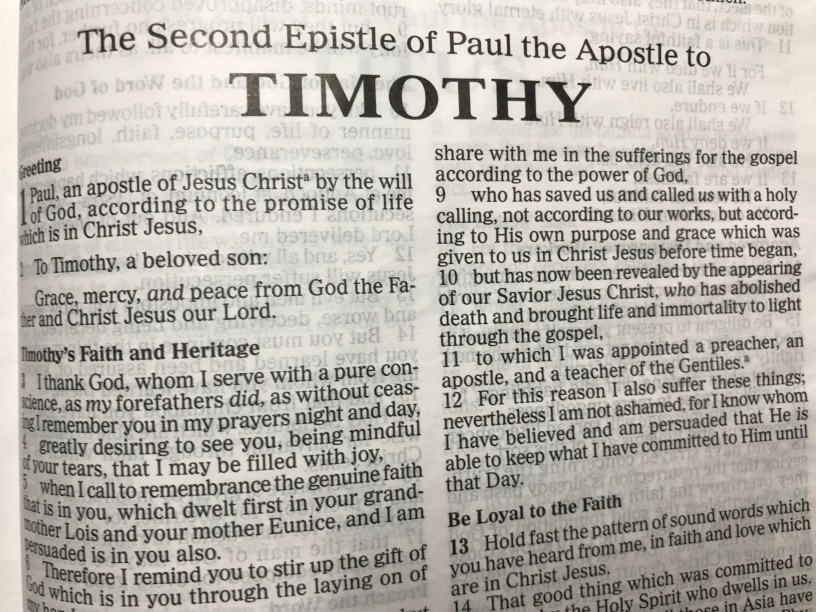
“Be diligent to present yourself approved to God, a worker who does not need to be ashamed, rightly dividing the word of truth.” 2 Timothy 2:15
I want to pick up where we left off last time. We saw that ‘rightly diving the word of truth’ is extremely important, but what does it mean and how do we do it? We know that ‘rightly dividing’ means ‘cutting a straight line’ in our study of God’s Word, but where do we start?
Keys and Clues
“The secret things belong to the Lord our God, but those things which are revealed belong to us and to our children forever, that we may do all the words of this law.”
God keeps many things ‘secret’ (Hebrew word is סָתַר, sathar, and means ‘hidden, concealed’). However, He also ‘reveals’ (Hebrew word is גֶּלֶה, galah, and means ‘uncovered, removed’) many things to His people. Our job as ‘right-dividers’ is to find the ‘keys and clues’ to what God has uncovered for us.
Finding keys and clues means a lengthy and careful approach to studying the Bible. I use this phrase to guide me in my study – ‘Text within context, from the original language, to the original reader.’ That means starting with the first sentence in a Book of the Bible and studying it verse-by-verse until you finish the Book. You won’t find ‘keys and clues’ to ‘rightly dividing’ the Word of truth if you start your study somewhere in the middle of a biblical writing, then try to announce an interpretation. It doesn’t work that way.
How would you read a letter that your dearest friend sent you? Would you start in the middle of the letter, read a few words, then try to determine what he or she meant? I think we can agree that’s a ridiculous way of looking at reading an important document, but it’s how many Christians and Bible teachers approach the Bible. They miss ‘keys and clues’ because they don’t follow a methodical approach to Bible study.
One of the first classes I took in Bible college more than 50 years ago was about how to study the Bible (Bible Hermeneutics). I called it the I M Bible Study Method. That’s short for Inductive Methodical Bible Study Method. I began teaching what I had learned to Christians at churches in the mid-1970s. You can read some of the curriculum from that course here. Keep in mind that this was a course I studied in Bible College, so much of the credit for what I taught goes to my professor and the textbooks we used at the time.
Study Notebook
I highly recommend that you develop a ‘study notebook’ for each Book of the Bible you study. You can make your notes as short or long as you like. The important thing is to keep notes about the ‘keys and clues’ you find during your study that would go to ‘rightly dividing the word of truth.’ Remember that Paul said we need to do that “to present yourself approved to God, a worker who does not need to be ashamed.”
I still have several notebooks and papers from my Bible studies through the years. Some were lost during the many moves I’ve done as a journalist – moving from one station to another to another, but at least I still have some. I’ve found it interesting to see what I found in Bible study as a young Christian and how many more ‘keys and clues’ I’ve found as I soon approach my 80th birthday. Bible study should be something we do throughout our Christian life. It’s not enough to study a Book once and think we’re finished with it.
The Holy Spirit is the One who ‘inspired’ the writing of Scripture, so He is also the One who will take you deeper and deeper into the gold mines of His Word as you continue to rely on Him to show you the way year after year. That’s one of the benefits of keeping a study notebook. You don’t forget the keys and clues you found in earlier studies and you can add more as you study and Books of the Bible through the years.
Divisions About Dividing
Paul wrote 2 Timothy sometime between 65 and 67 AD. Christian leaders probably asked Timothy for copies of the letter sometime after Paul’s martyrdom. We know from Paul’s first letter to Timothy that he told Timothy to “remain in Ephesus that you may charge some that they teach no other doctrine” (1 Timothy 1:3). Paul asked Timothy in his second letter to – “Do your utmost to come before winter” (2 Timothy 4:21). We don’t know whether Timothy arrived in time to see Paul before he was martyred, but Timothy did receive the letter. Timothy, being involved with the Christians in Ephesus, would most certainly read the letter to them. We also believe from Church history that the Apostle John ministered in Ephesus at some time during or after Timothy’s time there. John would have had access to both of Paul’s letters to Timothy from the Ephesian church. John was well known to the churches of Asia Minor and is believed to have died in Ephesus after being released Roman custody on the prison island of Patmos at the end of the 1st century. John influenced many of the churches of Asia Minor, which is probably why Jesus chose John to send the Revelation to the seven churches in Asia Minor. They would have all recognized John’s writing and received it as authentic. Those churches included Ephesus, Smyrna, Pergamos, Thyatira, Sardis, Philadelphia, and Laodicea (Revelation 1:11).
That means the early Church was reading 2 Timothy sometime in the 70s AD. Because John knew about the letter, he most likely shared it with his disciples who included some of the Apostolic Fathers of the Early Church.
We know Greek copies of 2 Timothy were known within the Christian communities because Polycarp quoted 2 Timothy 2:12 in a letter he wrote in about 110 AD. Polycarp was a disciple of the Apostle John and also the pastor of the church in Smyrna, which was mentioned in the Book of Revelation. He may have been the pastor of the Smyrna church when John wrote Revelation. Smyrna received high praise from Jesus Christ because of its strong stand for the Gospel.
Polycarp was a very old man when he wrote letters on his way to Rome to be martyred. He had memorized large portions of the letters of Paul and other Scripture, so he quoted and alluded to them often. Polycarp made an allusion to 2 Timothy 4:10 in one of his letters. He mentioned the Apostle Paul several times in his letters and was aware that he had been an apostle. Polycarp may or may not have met Paul, but he knew the Apostle John who knew Paul quite well and would have vouched for him and his ministry.
My point is that the leaders of the ‘early Church’ had copies of what Paul and the other apostles had said and written – in addition to what Jesus had said as quoted in the four Gospel accounts. They would have known the importance of ‘rightly dividing the word of truth’ and known its true meaning. Once the apostles were martyred, it fell on the shoulders of Polycarp, Clement of Rome, Ignatius of Antioch, and others to do the hard work of ‘rightly dividing’ God’s Word. From what I’ve read in their letters from the late 1st century and early 2nd century AD, they did their best to stay true to God’s Word and ‘cut a straight line.’ They had to withstand many inside and outside churches who wanted to make the lines ‘crooked’ so as to deceive church members and their leaders.
We begin to see ‘crooked’ lines in the early Church as early as Paul’s letter to the Galatians (e.g. Galatians 1:6-10; 3:1-4), which would have been from the middle of the 1st century. It didn’t take long for the enemy to deceive people using God’s Word – much like what he did to Eve (Genesis 3) and tried to do unsuccessfully to Jesus (Luke 4). The enemy is very good at getting believers and their leaders off-track. That’s what happens when we don’t ‘rightly divide’ God’s Word. We begin to veer away from the absolute truth that is God’s Word – and that causes big problems in the Church. It did in the 1st century, 2nd century, 3rd century, and all the centuries that have followed – right up to now in the 21st century.
Why would a teacher of God’s Word fall for such obvious deception on the part of the enemy? Pride? Spirit of compromise? Greed? Selfish ambition? Power hunger? Laziness? Stupidity? Evil mind and heart? Any teacher who veers even a ‘little’ from God’s Word should be called to task by other elders and church members. I have an entire section of eBooks dedicated to how to address false preaching and teaching in churches, denominations, and seminaries. I hope you’ll read it and consider what’s happening in your church. God will one day put a stop to all of the nonsense going on in churches and denominations, but His judgment will be strict and painful. I think it better for everyone involved if Christians do what the Apostle Peter recommended –
For the time has come for judgment to begin at the house of God; and if it begins with us first, what will be the end of those who do not obey the gospel of God? 1 Peter 4:17
Far too much is at stake to play games or waste time –
“Now “If the righteous one is scarcely saved, Where will the ungodly and the sinner appear?” 1 Peter 4:18
Next Time
Would you like some examples of ‘cutting’ God’s Word ‘straight’ and cutting it ‘crooked?’ Good. I’ll share a few with you in the next part of our series.
GraceLife © 1990-2026