
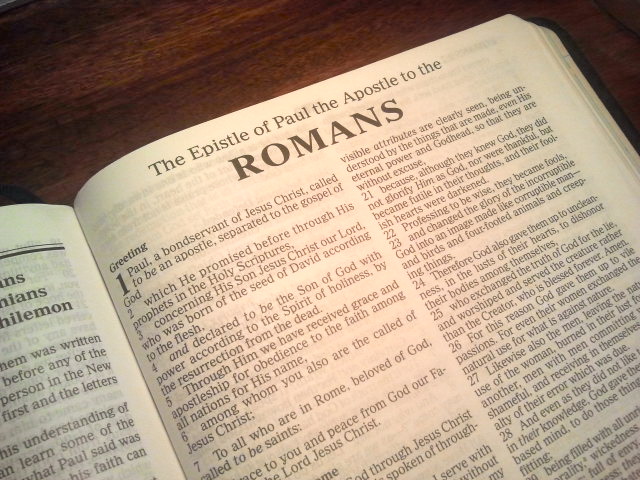
We will conclude our study into Romans chapter 7 today. We’ve seen previous parts of Chapter 7 where the Apostle Paul emphasized the fact that the Mosaic Law cannot save anyone from sin. We looked at verses 17 – 20 in the last part of our study, demonstrating from the Greek (present tense) that Paul was writing about the struggle he and all believers have with the sin nature. We move now to verses 21-25.
Rather than list each verb and its tense in this next section (as I did in the last), I’ll just say that all of the verbs in verses 21-25 are present tense except for one future tense verb. I’ll point that one out when we get to it in verse 24. The important thing to note is that Paul was writing about his personal struggle with sin at the time of his writing Romans. All Christians struggle with sinful thoughts and actions –
For the flesh lusts against the Spirit, and the Spirit against the flesh; and these are contrary to one another, so that you do not do the things that you wish. Galatians 5:17
(All verbs are present tense in this verse as well).
Verses 21 – 25
I find then a law, that evil is present with me, the one who wills to do good. For I delight in the law of God according to the inward man. But I see another law in my members, warring against the law of my mind, and bringing me into captivity to the law of sin which is in my members. O wretched man that I am! Who will deliver me from this body of death? I thank God—through Jesus Christ our Lord! So then, with the mind I myself serve the law of God, but with the flesh the law of sin.
ευρισκω αρα τον νομον τω θελοντι εμοι ποιειν το καλον οτι εμοι το κακον παρακειται συνηδομαι γαρ τω νομω του θεου κατα τον εσω ανθρωπον βλεπω δε ετερον νομον εν τοις μελεσιν μου αντιστρατευομενον τω νομω του νοος μου και αιχμαλωτιζοντα με τω νομω της αμαρτιας τω οντι εν τοις μελεσιν μου ταλαιπωρος εγω ανθρωπος τις με ρυσεται εκ του σωματος του θανατου τουτου ευχαριστω τω θεω δια ιησου χριστου του κυριου ημων αρα ουν αυτος εγω τω μεν νοι δουλευω νομω θεου τη δε σαρκι νομω αμαρτιας
Verse 21
I find then a law, that evil is present with me, the one who wills to do good.
ευρισκω αρα τον νομον τω θελοντι εμοι ποιειν το καλον οτι εμοι το κακον παρακειται
ευρισκω αρα τον νομον (heuriskō ara ton nomon) “I find so the principle” … heuriskō means ‘discovery after searching’ .. nomon means ‘law as general principle’ .. Paul found a general principle to be true through the process of personal discovery .. because the word ‘law’ is preceded by the article (the), ‘it could refer to a law as the constant rule of experience imposing itself on the will such as a modern scientific law, or the Mosaic law, or to the law of sin which Paul speaks of as in his members’ (Vincent, Word Studies in the New Testament, 1887) .. ‘The law, in short, which Paul has discovered by experience, is the constant fact that when his inclination is to do good, evil is present with him…Possibly Paul meant, in using the word, to convey at the same time the idea of an outward compulsion put on him by sin, which expressed itself in this constant incapacity to do the good he inclined to—authority or constraint as well as normality being included in his idea of the word.’ (Expositor’s Greek Testament) ..
τω θελοντι εμοι ποιειν το καλον (tō thelonti moi poein to kalon) “that desiring me to do good” … thelonti means ‘desire, wish for, want, intend’ .. kalon means ‘beautiful as outward sign of inward good, noble, honorable character’ .. this is something Christians should ‘desire’ in their lives, ‘to do good’ ..
οτι εμοι το κακον παρακειται (hoti emoi to kakon parakeital) “that me evil is present with” … kakon means ‘bad, evil in the widest sense’ .. parakeital means ‘to lie beside, be present with’ .. Paul’s deep desire was to ‘do good,’ but he struggled with a presence of evil within his flesh that caused him to sin .. evil is something we all have to contend with in our lives, and the lives of others, until God calls us home .. that’s what Paul referred to when he wrote, ‘that evil is present with me’ ..
Verse 22
For I delight in the law of God according to the inward man.
συνηδομαι γαρ τω νομω του θεου κατα τον εσω ανθρωπον
συνηδομαι γαρ τω νομω του θεου (sunēdomai gar tō nomō tou theou) “I delight for in the law of God” … sunēdomai means to ‘rejoice together, delight inwardly’ .. Paul’s words remind me of what King David wrote in Psalm 1 – ‘Blessed is the man Who walks not in the counsel of the ungodly, Nor stands in the path of sinners, Nor sits in the seat of the scornful; But his delight is in the law of the Lord, And in His law he meditates day and night. He shall be like a tree Planted by the rivers of water, That brings forth its fruit in its season, Whose leaf also shall not wither; And whatever he does shall prosper.’ .. Paul may have even had that Psalm in mind when he wrote those words to the Romans ..
κατα τον εσω ανθρωπον (kata ton esō anthrōpon) “according to the inward man” … Paul, like all true believers, was a ‘new man’ in Christ .. Paul experienced Christ in the ‘inward man’ .. that’s where the ‘new man’ lived .. Paul wrote the Corinthians earlier that, ‘Therefore we do not lose heart. Even though our outward man is perishing, yet the inward man is being renewed day by day.’ .. Paul knew that the ‘flesh’ of the outward man was perishing, but the ‘inward man’ was being renewed day by day .. Paul addressed the issue in more depth a few years after he wrote to the Romans –
This I say, therefore, and testify in the Lord, that you should no longer walk as the rest of the Gentiles walk, in the futility of their mind, having their understanding darkened, being alienated from the life of God, because of the ignorance that is in them, because of the blindness of their heart; who, being past feeling, have given themselves over to lewdness, to work all uncleanness with greediness. But you have not so learned Christ, if indeed you have heard Him and have been taught by Him, as the truth is in Jesus: that you put off, concerning your former conduct, the old man which grows corrupt according to the deceitful lusts, and be renewed in the spirit of your mind, and that you put on the new man which was created according to God, in true righteousness and holiness. Ephesians 4:17-24
Paul appealed to believers not to conduct themselves ‘as the rest of the Gentiles,’ but to ‘put off’ their former conduct, ‘the old man,’ and ‘be renewed in the spirit of your mind’ .. that’s a powerful demonstration of the battle that rages within every believer .. we are ‘new’ in spirit, but the ‘old man’ is still with us, slowly perishing, but still a challenge we have to face all day, every day ..
The ‘natural’ (unsaved) person does not have any physical or spiritual ability to “be renewed in the spirit” of their mind. Their conduct at all times is what Paul referred to as ‘the old man.’ Paul wrote earlier in Ephesians that all people are “dead in trespasses and sins.” It is only have salvation that a person is made ‘new’ in spirit because of God’s great love and mercy – ‘even when we were dead in trespasses, made us alive together with Christ (by grace you have been saved), and raised us up together, and made us sit together in the heavenly places in Christ Jesus’ (Ephesians 2:6-7). We have MUCH to be thankful for to God.
Verse 23
But I see another law in my members, warring against the law of my mind, and bringing me into captivity to the law of sin which is in my members.
βλεπω δε ετερον νομον εν τοις μελεσιν μου αντιστρατευομενον τω νομω του νοος μου και αιχμαλωτιζοντα με τω νομω της αμαρτιας τω οντι εν τοις μελεσιν μου
βλεπω δε ετερον νομον εν τοις μελεσιν μου (blepō de heteron nomen en tois melesin mou) “I see however another law in the members of me” … Paul addressed a ‘law’ in verse 21 where he wrote – ‘I find then a law, that evil is present with me, the one who wills to do good.’ .. he referred to ‘the law of God according to the inward man’ in verse 22 .. Paul then referred to ‘another law’ that resided in his ‘members’ that warred against the ‘law’ of his mind, bringing him into ‘captivity’ to the ‘law of sin which is in my members’ .. the word melesin means ‘a limb of the body, a part of the body’ .. the context would seem to direct us to understand that Paul’s struggle was a ‘fleshly’ one that impacted his physical body (members) ..
αντιστρατευομενον τω νομω του νοος μου και αιχμαλωτιζοντα με τω νομω της αμαρτιας (antistrateuomenon tō nomō tou noos mou kai aichmalōtizonta me tō nomō tēs amartias) “warring against the law of the mind of me and making captive me to the law of sin” .. antistrateuomenon means ‘to make war against, campaign against’ .. aichmalōtizonta means ‘to take captive, to subdue, ensnare, take prisoner’ .. tō nomō tēs amartias means ‘the law of sin, the law of missing the mark, the law of failure, the law of committing sinful deeds’ ..
This may come as a surprise to some Christians – that there exists ‘a law of sin’ and that a Christian can be taken captive to it through a campaign of spiritual warfare. However, given the many other writings of the Apostle Paul and other apostles we should not be surprised. Was it not Paul who wrote about spiritual warfare in Ephesians 6:10-18? He wrote that Christians needed to ‘be strong in the Lord and in the power of His might.’ He wrote that Christians needed to put on ‘the whole armor of God’ so that they ‘may be able to stand against the wiles of the devil.’ Paul wrote that we ‘wrestle’ against ‘principalities, powers, rulers of the darkness of this age, and spiritual hosts of wickedness in the heavenly places.’ Paul wrote that it was necessary for God’s people to take up ‘the whole armor of God’ so that we might be able to ‘withstand in the evil day, and having done all, to stand.’
What we learn from Ephesians 6 and other apostolic writings is that it is possible for a believer to ‘fall’ and ‘fail.’ That’s what Paul referred to in Romans 7:23 – ‘But I see another law in my members, warring against the law of my mind, and bringing me into captivity to the law of sin which is in my members.’ The potential for failure and falling into sinful thinking and behavior is a possibility for believers because of ‘another law’ that warred against the ‘law’ of his mind. It is the battle of the flesh and spirit Paul referred to in Galatians 5.
Here’s an interesting idea to consider from Dr. Wuest –
Paul does not see in his nature two normal modes in which certain forces operate: he sees two authorities saying to him, Do this, and the higher succumbing to the lower. As the lower prevails, it leads him captive to the law of sin which is in his members, or in other words, to itself: ‘of whom a man is overcome, of the same is he brought in bondage.’ The end therefore is that man as a creature of flesh, living under law, does what sin enjoins. It is the law of sin to which he gives obedience. Kenneth Wuest, Romans in the Greek New Testament, Eerdman’s, 1955
Verse 24
O wretched man that I am! Who will deliver me from this body of death?
ταλαιπωρος εγω ανθρωπος τις με ρυσεται εκ του σωματος του θανατου τουτου
ταλαιπωρος εγω ανθρωπος (talaipōros egō anthrōpos) “o wretched man I am” … talaipōros means ‘distressed, miserable, afflicted, wretched, beaten-down’ .. this Greek word is used only twice in the New Testament, once by Paul and once by the Apostle John .. Jesus, who dictated these words to John, used the word in Revelation 3:17 as part of describing the ‘church in Laodicea’ .. a group of Christians that the Lord said were ‘wretched and miserable and and poor and blind and naked’ (ταλαίπωρος καὶ ἐλεεινὸς καὶ πτωχὸς καὶ τυφλὸς καὶ γυμνός) .. some of the churches that Jesus addressed directly in Revelation 2 and 3 are unfortunate examples of what we see in churches through the past centuries and today .. Paul wrote a letter to Laodicea and John ministered to them, but they didn’t heed the messengers or the message .. with Christ’s dictated letter, it was a final warning – ‘I counsel you to buy from Me gold refined in the fire, that you may be rich; and white garments, that you may be clothed, that the shame of your nakedness may not be revealed; and anoint your eyes with eye salve, that you may see. As many as I love, I rebuke and chasten.Therefore be zealous and repent.’
τις με ρυσεται εκ του σωματος του θανατου τουτου (tis me rusetai ek tou sōmatos tou thanatou toutou) “who me will deliver out of the body of death this” .. I mentioned earlier that one of the verbs in this section is future tense .. rusetai is that verb (future indicative middle, 3rd personal singular) .. Paul was asking who would be able to ‘deliver from danger or destruction, rescue, snatch up’ him ‘from this body of death’ .. who out there in the universe would be able to deliver Paul from the ‘wretched man’ that lived within his ‘members’ .. I think we know the answer even before reading the next verse ..
Verse 25
I thank God—through Jesus Christ our Lord! So then, with the mind I myself serve the law of God, but with the flesh the law of sin.
ευχαριστω τω θεω δια ιησου χριστου του κυριου ημων αρα ουν αυτος εγω τω μεν νοι δουλευω νομω θεου τη δε σαρκι νομω αμαρτιας
ευχαριστω τω θεω δια ιησου χριστου του κυριου ημων (eucharisto tō theō dia Iēsou Christou tou kuriou hēmōn) “thanks then be to God through Jesus Christ the Lord of us” … Jesus is the only One in the universe any of us can turn to for salvation from sin and death, the wretched man, and to eternal life .. that’s the solution I would have expected from the Apostle Paul .. I would also expect Paul to sum up his teaching precisely and succinctly ..
αρα ουν αυτος εγω τω μεν νοι δουλευω νομω θεου τη δε σαρκι νομω αμαρτιας (ara oun autos egō tō men noi douleuō nomō theou tē de sarki nomō hamartias) “then so myself I with the indeed mind serve law God’s but with the flesh the law of sin” .. just a reminder that the verb douleuō (serve) is a present tense verb (indicative active) .. Paul ‘served’ God’s law with his mind, ‘but with the flesh the law of sin’ .. that is the condition of every Christian .. our flesh is at war with our mind .. or as Paul wrote to the Galatians, ‘For the flesh lusts against the Spirit, and the Spirit against the flesh; and these are contrary to one another, so that you do not do the things that you wish.’
I find Paul’s words comforting because living as a Christian in this present world (age) is challenging. There are things we want to do that we know are the right thing to do because of what God’s Word tells us and what we sense in our mind and spirit. However, we sometimes do not do those things and even do the opposite. That threw me when I was a young Christian. I wondered whether I had really been saved or if I had somehow lost the gift of salvation God had given me. Romans 7 became a great comfort to me when I studied it from the Greek and realized what Paul was saying. Galatians 5 confirmed it. As Paul wrote, ‘I thank God—through Jesus Christ our Lord!’ We owe everything to Jesus. Everything.
Other Commentaries
This passage does not represent the apostle as one that walked after the flesh, but as one that had it greatly at heart, not to walk so. And if there are those who abuse this passage, as they also do the other Scriptures, to their own destruction, yet serious Christians find cause to bless God for having thus provided for their support and comfort. We are not, because of the abuse of such as are blinded by their own lusts, to find fault with the scripture, or any just and well warranted interpretation of it. And no man who is not engaged in this conflict, can clearly understand the meaning of these words, or rightly judge concerning this painful conflict, which led the apostle to bemoan himself as a wretched man, constrained to what he abhorred. He could not deliver himself; and this made him the more fervently thank God for the way of salvation revealed through Jesus Christ, which promised him, in the end, deliverance from this enemy. So then, says he, I myself, with my mind, my prevailing judgement, affections, and purposes, as a regenerate man, by Divine grace, serve and obey the law of God; but with the flesh, the carnal nature, the remains of depravity, I serve the law of sin, which wars against the law of my mind. Not serving it so as to live in it, or to allow it, but as unable to free himself from it, even in his very best state, and needing to look for help and deliverance out of himself. It is evident that he thanks God for Christ, as our deliverer, as our atonement and righteousness in himself, and not because of any holiness wrought in us. He knew of no such salvation, and disowned any such title to it. He was willing to act in all points agreeable to the law, in his mind and conscience, but was hindered by indwelling sin, and never attained the perfection the law requires. What can be deliverance for a man always sinful, but the free grace of God, as offered in Christ Jesus? The power of Divine grace, and of the Holy Spirit, could root out sin from our hearts even in this life, if Divine wisdom had not otherwise thought fit. But it is suffered, that Christians might constantly feel, and understand thoroughly, the wretched state from which Divine grace saves them; might be kept from trusting in themselves; and might ever hold all their consolation and hope, from the rich and free grace of God in Christ. Matthew Henry’s Concise Commentary
This is not an unsaved man who is crying, “O wretched man that I am.”; this is a saved man … He is helpless. His shoulders are pinned to the floor-he has been wrestled down. Like old Jacob, he has been crippled. He is calling for help from the outside. ‘I thank God through Jesus Christ our Lord. So then with the mind I myself serve the law of God; but with the flesh the law of sin” … This is the answer to Paul’s SOS. God has provided deliverance. It introduces chapter 8 in which the deliverance is given in detail. Both salvation and sanctification come through Christ; He has provided everything we need. Through the Bible with J. Vernon McGee, Volume IV, 1983, p 694
Romans Resources
Commentary on Romans “The Gospel of God” Chapter 1 Verses 1-15
Commentary on Romans “The Gospel of God” Chapter 1 Verses 16-17
Commentary on Romans “The Gospel of God” Chapter 1:18 – 25
Commentary on Romans “The Gospel of God” Chapter 1:25-32
Commentary on Romans “The Gospel of God” Chapter 2:1-29
Commentary on Romans “The Gospel of God” Chapter 3
Commentary on Romans “The Gospel of God”Chapter 4
Commentary on Romans “The Gospel of God” Chapter 5
Commentary on Romans “The Gospel of God” Chapter 6
Commentary on Romans “The Gospel of God” Chapter 7
Next Time
We will look at Romans 8:1 in the next part of our study of the Gospel of God.
Scripture taken from the New King James Version®. Copyright © 1982 by Thomas Nelson. Used by permission. All rights reserved.
GraceLife © 1990-2026


